The best hybrid mobile app development company for you has shipped apps in your chosen framework, shows you its code and release process, and fits your budget and time zone. A full-service agency with offshore delivery suits startups and small businesses that want one app on iOS and Android at a sensible cost. A local studio suits teams that want workshops in the same room. An enterprise consultancy suits regulated corporates. A framework specialist suits founders who have already picked Flutter or React Native.
Most buyers struggle because every vendor page says the same thing: scalable, seamless, award-winning. The claims are interchangeable, so you cannot tell a team that has shipped ten cross-platform apps from one that is learning on your budget.
This article sorts the market into four kinds of provider and gives each the same breakdown. Eagle Technologies comes first because this is our blog, and we say plainly where we are not the right fit. After the four options, you get a side-by-side table and a checklist to shortlist and vet vendors.
1. Eagle Technologies
Eagle Technologies is a full-service agency founded in 2012, with headquarters in South Africa and an engineering centre in Jaipur, India. It builds apps in Flutter and React Native, and also native iOS and Android, so the approach follows your needs and not the vendor's habit.
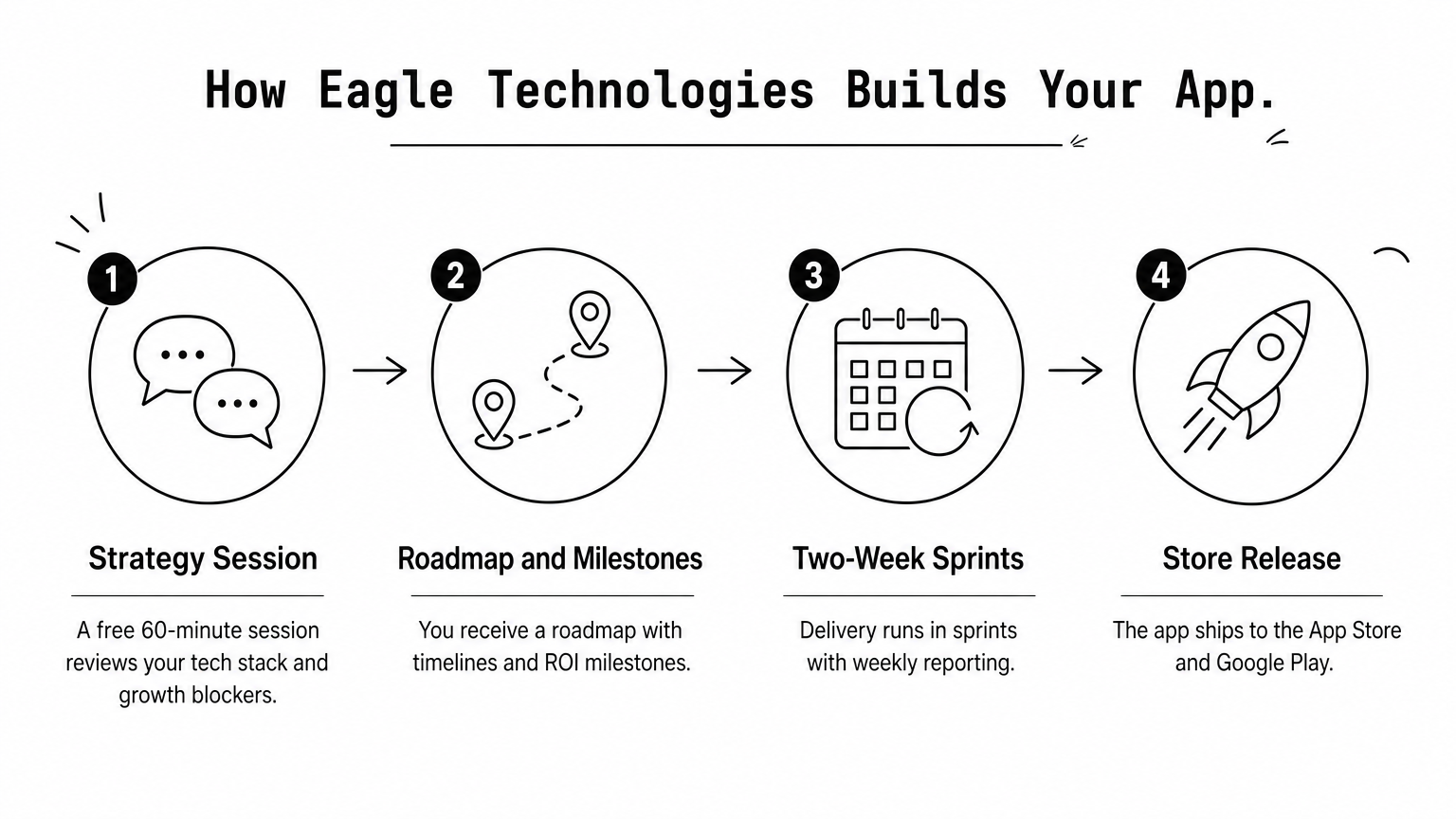
How it works
Work starts with a free 60-minute strategy session that reviews your tech stack and growth blockers. You then receive a roadmap with timelines and ROI milestones, and delivery runs in two-week sprints with weekly reporting. Design is done in Figma, and fixed-scope pilots usually finish in 2 to 6 weeks.
You can engage Eagle Technologies in two ways:
- Project delivery: a scoped build, from design to App Store and Google Play release.
- Dedicated developers: iOS developers (Swift, SwiftUI) or Android developers (Kotlin, Jetpack Compose) on hourly, part-time, or full-time terms. They start within 3 to 7 business days, with a 2 to 4 week paid trial.
One partner can design, build, and market your app, which removes the hand-offs between three separate vendors.
Who it suits
It suits startups, small and mid-sized businesses, and remote-first teams in South Africa, the wider Africa region, the US, the UK, and the EU. These buyers want an offshore cost base with English-first communication and IST overlap. Invoices can be in INR or ZAR, NDAs are standard, and there are no lock-in contracts.
The trade-off is location. If you need the team in your office every week, a local studio fits better.
2. Local app development studio
A local studio is a small or mid-sized agency in your own city or country. It is the right pick when you want in-person workshops and identical working hours, and it usually charges more per hour than an offshore team.

How it works
You meet the team, map the app on a whiteboard, and sign off scope face to face. Most studios quote a fixed project or a monthly team rate. Their edge is local knowledge: payment methods your customers use, local languages, and data-protection rules such as POPIA in South Africa.
Typical strengths and limits:
- Strength: fast decisions, since you can walk into a meeting.
- Strength: easy legal recourse under your own country's law.
- Limit: smaller benches, so a key developer leaving can stall the project.
- Limit: higher rates and less room to scale the team up quickly.
Who it suits
Founders who value relationships over rates suit this model. So do businesses in regulated or sensitive sectors that prefer data and people to stay in-country.
Pay the local premium only when proximity changes the outcome, such as on-site discovery or compliance reviews.
Ask whether the studio builds hybrid apps in-house or subcontracts the work. A studio that outsources quietly gives you a middleman markup without the proximity benefit.
3. Enterprise consultancy
An enterprise consultancy is a large systems integrator or digital consultancy with offices in several countries. It is the safest choice for complex integrations and audit requirements, and the slowest and most expensive way to ship a simple app.
How it works
Expect a formal process: discovery phase, architecture review, security assessment, then phased delivery with change-control documents. The team often includes architects, project managers, and QA leads, not only developers. Hybrid frameworks are chosen to share one codebase across iOS and Android while connecting to core systems such as ERP and identity platforms.
Who it suits
It suits corporates and public-sector bodies that need vendor risk reviews, service-level agreements, and large teams on call. If your app is a single customer-facing product, you may pay for governance you do not need.
Choose an enterprise consultancy for the integration and compliance load, not for the app itself.
Check minimum project sizes early. Many consultancies set a floor that rules out an MVP, and junior developers often do the build while senior staff sell the deal.
4. Framework specialist studio
A framework specialist is a boutique team that builds almost only in Flutter, React Native, or Ionic. It gives the deepest framework expertise and the narrowest service range, so you usually need to source design, marketing, or backend work elsewhere.

How it works
The framework choice matters because the options differ. Flutter uses Dart and draws its own interface, which gives consistent visuals on both platforms. React Native uses JavaScript or TypeScript and renders native components. Ionic with Capacitor wraps web technology in a native shell, which suits content-heavy business apps and teams with web skills.
A good specialist explains why one fits your app and shows a published app in that framework.
Who it suits
It suits product owners who have already decided on a framework, or teams that already have a backend and designer and need senior mobile engineers only. It is a weaker fit if you want one vendor to handle design, development, and growth.
A specialist wins on framework depth and loses on breadth, so match it to what you already have in-house.
Also ask how the studio handles platform features such as push notifications, biometrics, and offline storage. Hybrid apps reach native features through plugins, and a specialist should know which plugins are maintained.
How to shortlist and vet your hybrid app partner
Shortlist two or three providers from the four types, ask each for the same scoped quote, and judge them on evidence of shipped work, not on pitch decks. Hybrid suits business apps built on forms, catalogues, bookings, and dashboards, while heavy 3D graphics or deep hardware work often justifies native.
Side-by-side comparison
| Option | Best for | Team location | Main risk |
|---|---|---|---|
| Eagle Technologies | Startups, SMBs, and remote-first teams wanting build and growth support | South Africa HQ, Jaipur delivery | Team is not in your office |
| Local studio | In-person workshops and local compliance | Your city or country | Higher hourly cost, small bench |
| Enterprise consultancy | Regulated, integration-heavy projects | Multi-country offices | Slow start, high minimums |
| Framework specialist | Teams with a chosen framework and existing design or backend | Varies | Narrow scope beyond the app |
Checks before you sign
Give every vendor the same brief, such as a 10-screen app with login, payments, and push notifications, so the quotes are comparable. Then run these checks:
- Ask for two live apps on the App Store and Google Play built with your framework.
- Confirm in writing that you own the source code and IP.
- Ask how they test on real iOS and Android devices, not only emulators.
- Agree the sprint length and reporting rhythm before work starts.
- Plan post-launch support, because iOS and Android release major updates every year.
- Start with a fixed-scope pilot before committing to the full build.
The vendor that answers these six questions with specifics, not slogans, is the one to shortlist.
Pick the partner, then run a pilot
The right hybrid partner depends on where you need the team and how much process your project demands. Offshore full-service agencies balance cost and breadth, local studios bring proximity, enterprise consultancies carry integration risk, and framework specialists offer depth. Match the type to your constraint first, then compare individual vendors.
Whichever you choose, insist on proof from shipped apps, written IP ownership, and a small pilot before the full contract. Those three steps filter out most weak vendors.
If you want a second opinion on your scope or framework choice, talk to Eagle Technologies about your app and bring your shortlist along.