
The best SEO expert services match the size of your problem to the right kind of provider. A small business with a handful of target keywords is usually best served by a fixed-price managed plan. A company with its own developers and writers needs a consultant for direction, and a large or technical site needs a specialist agency. Whichever you pick, look for a clear scope, honest reporting and no promise of guaranteed rankings.
Choosing is hard because every provider sounds the same. Every profile claims white-hat tactics, years of experience and proven results, yet quotes for similar work can differ by a factor of ten. You end up comparing hourly rates against monthly retainers against project fees, and none of them line up.
This article sets out six ways to hire SEO help: managed plans, independent consultants, marketplace freelancers, full-service agencies, technical specialists and local SEO specialists. For each one you get what is included, who it suits and what it costs. A final section compares them side by side with a worked cost example. We sell SEO plans at Eagle Technologies, so we list ours first and say plainly where another option fits you better.
1. Eagle Technologies managed SEO plans
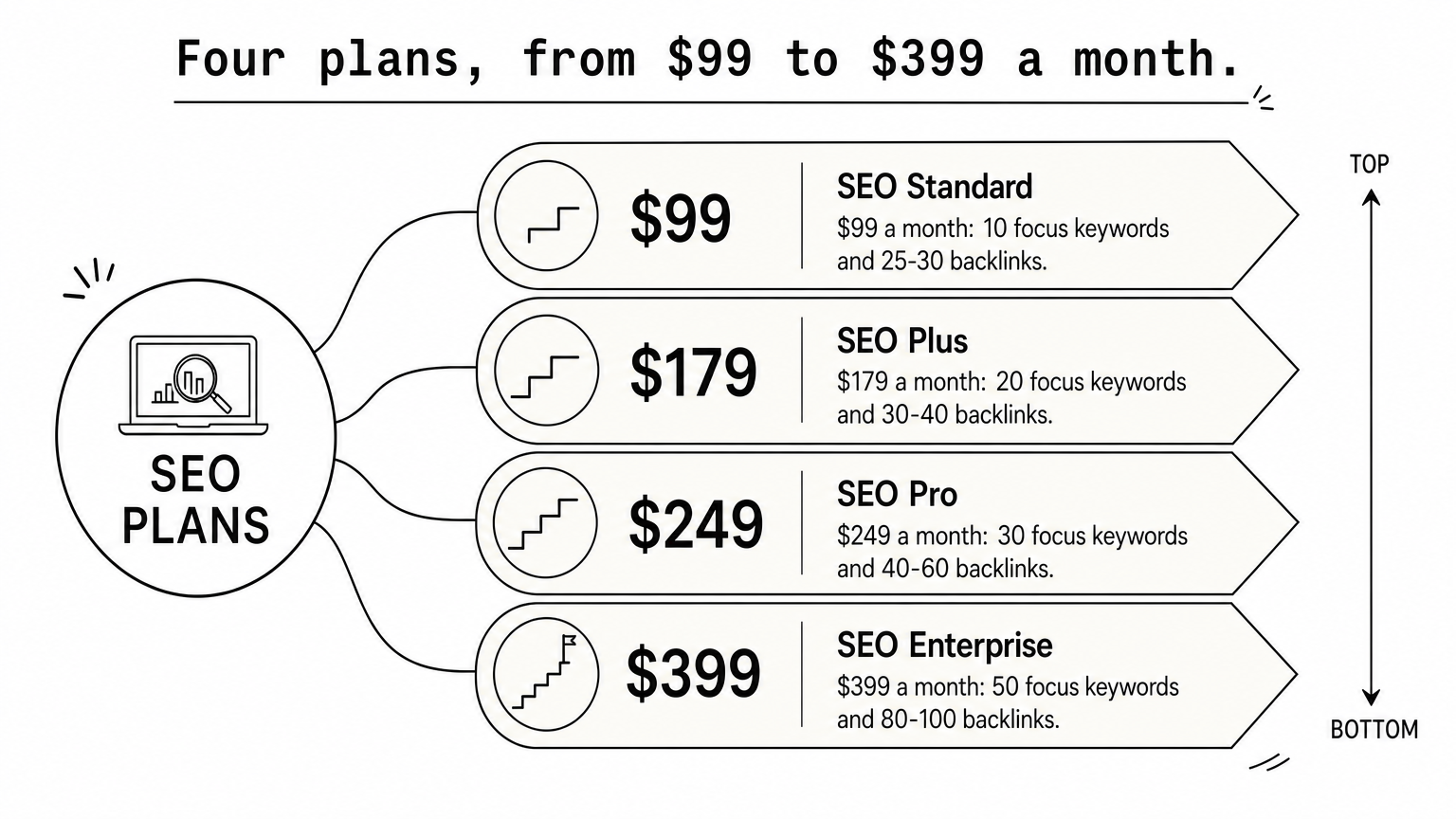
Eagle Technologies sells SEO as fixed monthly plans from $99 to $399, so you know the scope and the price before any work starts. It is a digital marketing and web development agency founded in 2012, with its headquarters in South Africa and a delivery centre in Jaipur, India.
What you get
Every plan covers keyword research, on-page fixes, backlinks and reporting. The plans differ in volume: more focus keywords, more backlinks and more blog posts as you move up. You receive 15-day and 30-day work reports with ranking snapshots, and a senior lead reviews every deliverable.
Work begins with a free SEO audit and a 60-minute strategy session. For bigger or more technical sites, the wider Search Engine Optimization service adds technical audits, indexation checks and competitive gap analysis. Each recommendation is documented with its effort, impact and owner.
A fixed plan with named deliverables is far easier to judge than a vague promise of more traffic.
Who it suits
The plans fit startups, small and mid-sized businesses and enterprise teams that want organic growth without hiring a full in-house SEO team. Standard is built for small businesses, Plus for medium, Pro for large and Enterprise for ecommerce and scale.
- Best for: businesses that want execution included, predictable monthly spend and shared reporting.
- Skip it if: you want guaranteed rankings. Eagle does not guarantee specific positions, only disciplined execution, clear reporting and strategies that follow search guidelines. That is the honest position for any provider.
What it costs
Prices are listed in US dollars, and Eagle can invoice in INR or ZAR to match your region. Plans run in 1, 3 or 6 month cycles with no lock-in and no hidden costs. Each plan lists a page 1 fee of $10 per keyword, so confirm how it applies in your proposal.
| Plan | Price per month | Focus keywords | Backlinks per month | Blogs per cycle |
|---|---|---|---|---|
| SEO Standard | $99 | 10 | 25-30 | 1 |
| SEO Plus | $179 | 20 | 30-40 | 2 |
| SEO Pro | $249 | 30 | 40-60 | 3 |
| SEO Enterprise | $399 | 50 | 80-100 | 5 |
These prices carry discounts of $30 to $100 off the earlier list prices of $129 to $499. If you want a person rather than a package, dedicated specialists cost $799 (Monthly SEO Specialist), $1,299 (Growth SEO Specialist) or $1,899 (Enterprise SEO Lead) per month.
2. Independent SEO consultant
An independent SEO consultant gives you senior judgment on what to fix first and leaves the fixing to you or your developers. Among SEO services consultants, this is the option for teams that need direction more than labor.
What you get
You typically receive a site audit, a keyword map and a prioritized roadmap, followed by regular review calls. Execution sits with you, your developer and your writers, so the consultant's value lies in deciding which fixes pay back first.
Ask to see a redacted sample audit before you commit. A good one ranks issues by impact and effort, names an owner for each and avoids padding with generic checklist items that apply to every site.
A consultant is paid for decisions, so judge them on the quality of the roadmap, not the length of the report.
Who it suits
This works when you already have developers and content people who can act on advice. It also suits a founder who wants an independent second opinion on what an agency is proposing.
- Best for: teams with in-house implementation capacity, one-off audits and second opinions.
- Skip it if: nobody on your side can implement fixes, or you need ongoing link building and content production.
What it costs
Consultants usually bill hourly or by fixed project, and senior people charge more per hour than the marketplace averages in the next option. Because you are paying for judgment, the sensible first purchase is a fixed-price audit with a written list of deliverables.
Before you agree to any ongoing retainer, ask for three things in writing:
- The number of hours included each month.
- What you receive at the end of each month.
- Who carries out the implementation.
3. Freelance marketplace SEO experts
Freelance marketplaces give you the widest choice and the lowest hourly rates, but you do all the vetting yourself. Upwork puts typical SEO expert rates at $15 to $35 per hour, depending on scope and experience.

What you get
You browse profiles, interview candidates and hire hourly or by milestone. Most listed experts work with Ahrefs, Semrush, Screaming Frog and Google Search Console, and cover audits, on-page work, link building and reporting. The limit is capacity: one person can only do so much in a month.
Quality varies widely. Claims such as two decades of experience or thousands of optimized sites are self-reported, so check them against work history, client feedback and a small paid test. An audit or keyword research task before a long engagement costs little and reveals a lot.
On a marketplace, the cheapest rate is rarely the cheapest outcome, so test with a small paid project first.
Who it suits
This suits buyers who know enough SEO to brief the work and check the output. It is also useful for defined, one-off jobs such as an audit or a round of on-page rewrites.
- Best for: tight budgets, specific tasks and owners who can manage freelancers.
- Skip it if: you want a team, strategy and accountability from one provider with no management effort on your side.
What it costs
Marketplace project pricing varies with scope. The ranges below are the ones published by Upwork, and your quote depends on site size and goals.
| Project type | Typical range |
|---|---|
| Technical SEO audit | $500 to $2,000 |
| On-page optimization | $1,000 to $3,000 |
| Link-building campaign | $1,500 to $5,000 |
| Content strategy | $2,000 to $5,000 |
| Ongoing SEO management | $3,000 to $10,000 |
4. Full-service digital agency
A full-service digital agency bundles SEO with web development, content and paid advertising, so one team handles both the traffic and the site that converts it. It is the right choice when SEO cannot be separated from a rebuild or a wider marketing plan.
What you get
Expect a team rather than a person: a strategist, writers, developers and link builders working from one scoped proposal and monthly report. The usual SEO scope includes:
- An initial audit and keyword plan.
- Technical and on-page fixes.
- Content production.
- Link building.
- Monthly reporting and review calls.
The advantage is coordination. When the SEO plan needs a new page template, the developers sit down the hall, not in another company. The risk is that SEO becomes one line in a large retainer and gets less attention than the paid campaigns.
With an agency, the question is not whether SEO is offered but who actually owns it day to day.
Who it suits
This fits businesses that are rebuilding a website, launching ecommerce or running Google Ads alongside SEO and want one accountable partner for all of it.
- Best for: mid-sized and larger companies with several marketing needs.
- Skip it if: you only need SEO on a small budget, because you may pay for overhead and services you do not use.
What it costs
Agencies work on monthly retainers, sometimes with a setup fee, and price through scoped proposals rather than public rates. That makes comparison harder, so put each proposal into the same shape.
Count the focus keywords, content pieces, links, reports and hours each one includes, and ask about the minimum term and cancellation rules. A lower retainer that covers half the work is not cheaper.
5. Technical and ecommerce SEO specialist
A technical SEO specialist focuses on one hard part of the job, such as crawling, indexation, site migrations or large ecommerce catalogs. You hire one when the problem lies in how the site is built rather than in how much content it has.
What you get
The work centers on how search engines crawl and index your site. That covers Core Web Vitals, structured data, canonical tags and redirects. On ecommerce sites it extends to faceted navigation and category structure, and on multi-country sites to hreflang.
For a migration, a specialist builds a redirect map before launch and checks indexation after it. Done well, this protects the rankings you already have, which is often worth more than any new content.
On large sites, fixing what blocks indexing usually beats publishing more pages.
Who it suits
This suits sites with thousands of URLs, platform changes or several languages and countries. It also fits stores on Shopify, WooCommerce or Magento that have outgrown generic advice.
- Best for: large catalogs, planned migrations and sites with unexplained traffic drops.
- Skip it if: you run a small brochure site, where a managed plan or consultant covers the technical basics.
What it costs
Specialists bill by fixed project for audits and migrations, or by retainer for ongoing technical work. Because the scope is narrower and the people more senior, expect higher rates than a generalist plan.
Ask for migrations to be priced as a fixed project with milestones before launch and a check after launch. Also ask who makes the fixes. If your developers do, budget for their time as well.
6. Local SEO specialist
A local SEO specialist gets a business found on Google Maps and in nearby searches, which is a different job from ranking a national website. It is the most focused and often the most affordable way to bring in customers from your own area.

What you get
The core work is your Google Business Profile: correct categories, services, photos and posts. It also covers consistent name, address and phone details across directories, local landing pages and a steady process for collecting reviews.
Look at who ranks for your main local searches. If a directory holds the top spots, you need a strong listing there too, because a mention on an authoritative local site helps your own visibility.
For a local business, an accurate and active Google Business Profile does more than most website changes.
Who it suits
This suits service businesses with a physical location or defined service area, such as clinics, trades, restaurants and professional offices.
- Best for: businesses whose customers come from a town, city or region.
- Skip it if: you sell nationally online with no local customers, where local work adds little.
What it costs
Local SEO is usually sold as a modest monthly retainer or a fixed setup fee, because the scope is narrower than full SEO. Verify what the price includes: how many directory listings, how many profile posts and whether review handling is part of the deal. A cheap package that only claims a listing is not a local SEO service.
How to compare and choose between them
Choose by who will do the work. If you need execution, pick a managed plan or agency. If you need direction, pick a consultant. If your site is complex or local, pick a specialist.
Side-by-side comparison
| Option | Best for | How it bills | Main risk |
|---|---|---|---|
| Managed plan | Small to mid-sized businesses needing execution | Fixed monthly, from $99 at Eagle | Fixed volumes may not fit unusual sites |
| Independent consultant | Teams that can implement | Hourly or fixed project | Advice without execution |
| Marketplace freelancer | Tight budgets, defined tasks | About $15 to $35 per hour | Vetting falls on you |
| Full-service agency | SEO tied to web and ads | Monthly retainer | Paying for unused services |
| Technical specialist | Large or complex sites | Project or retainer | Overkill for small sites |
| Local specialist | Location-based businesses | Small retainer or setup fee | Limited reach beyond local searches |
Here is a worked example. A small business wants to target 10 keywords for six months. On a managed plan like SEO Standard that is 6 x $99 = $594, with backlinks and a blog included. A freelancer working 20 hours a month at $15 to $35 per hour costs $300 to $700 a month, or $1,800 to $4,200 over six months, and you manage the work yourself. The plan is cheaper if its scope matches your site. The freelancer wins if you need only a one-off audit.
Questions to ask before you sign
Put these to every provider on your shortlist and compare the answers:
- What exactly will you do in month one, and what will I see at the end of it?
- Who does the work, and who reviews it?
- How do you build links? Purchased spam links put your site at risk with every Google update.
- How do you report? Look for rankings, organic traffic and leads, not impressions alone.
- What happens if I leave? Check for lock-in and that you keep access to your data.
- How do you handle AI search, such as Google AI Overviews and ChatGPT answers? Good providers structure content so it can be cited there.
Treat any guarantee of a number one ranking as a red flag. Google states that no one can guarantee a top ranking.
How long results take
Expect first movement in 3 to 6 months and significant progress in 6 to 12 months or longer. Technical fixes can show an effect within weeks, while competitive keywords and new sites take longer.
Because of that, judge a provider in two stages. In months one to three, check the work delivered: fixes shipped, content published, reports on time. From month four, look at indexed pages, impressions and rankings, then leads. A 3 or 6 month cycle gives a fair test without a long lock-in.
Judge an SEO provider by the work delivered in months one to three, and by results from month four onward.
Picking your SEO expert
The right SEO expert depends on what you lack. If you lack hands to do the work, choose a managed plan or an agency. If you lack direction, hire a consultant. If your site is large, technical or local, hire a specialist. Whatever you choose, get the scope, the reporting and the exit terms in writing, and ignore anyone who guarantees rankings.
Run the six questions above past every shortlisted provider, and compare quotes on the same basis: keywords covered, content, links, hours and minimum term. Give the work three to six months before you decide whether it is working.
If a fixed plan sounds like your fit, you can book a free SEO audit with Eagle Technologies and see the scope and price before you commit to anything.