The best mobile app development company in Australia is the one that matches your project size, budget and industry, not one name for every buyer. EB Pearls suits large, complex builds that need a big in-house team. Appetiser, Buzinga and App Boxer suit startups and mid-sized businesses that want a collaborative local studio. Eagle Technologies suits teams that want to keep build costs down and can work across a time-zone gap.
Searching for a mobile app development company in Australia gives you long directories where every agency calls itself award-winning. That does not help you decide. You need to know what each company builds, who it works best for, and what to question before you sign. A wrong pick costs months and a large share of your budget.
This article profiles seven companies in the same format so you can compare them directly. It then shows how to weigh them against each other and what an app project typically costs. One disclosure: Eagle Technologies publishes this blog, so it is listed first, and it is the only company here that is not Australian-based. Confirm every detail on each company's own site before you shortlist.
1. Eagle Technologies
Eagle Technologies is an offshore option: an agency headquartered in South Africa with an engineering centre in Jaipur, India, that builds native and cross-platform apps for international clients. It is not an Australian studio. It leads this list because it answers a different need, which is lower-cost delivery with a dedicated team rather than a local office.

What it offers
Eagle Technologies was founded in 2012, has more than 50 specialists and reports 500+ projects delivered. Its mobile app development service covers native iOS and Android apps plus cross-platform builds in Flutter and React Native, and apps are prepared to be App Store ready.
- Native iOS work in Swift and SwiftUI, and native Android work in Kotlin and Jetpack Compose
- Cross-platform apps in Flutter and React Native
- A separate mobile app design service, with fixed-scope pilots usually complete within 2 to 6 weeks
- Dedicated iOS and Android developers on hourly, part-time or full-time terms, starting within 3 to 7 business days, with a 2 to 4 week paid trial
- Two-week sprints with weekly reporting, standard NDAs and no lock-in contracts
Who it suits and what to check
It suits startups and growing businesses with a defined scope, and product teams that need extra iOS or Android capacity without hiring locally. Its stated phone hours are 9:30am to 7pm IST, which means mid-afternoon onward in Sydney or Melbourne. Plan your standing calls for the Australian afternoon.
Check three things before you commit. Eagle can invoice in INR or ZAR, so ask how that works for an Australian business and budget for exchange-rate movement. There is no Australian office, so agree data handling and IP ownership in writing, especially if your app collects personal information from Australians. A free 60-minute strategy session is available, which is a low-risk way to test the fit.
A cheaper build only saves money when scope, communication and ownership terms are settled before the first sprint.
2. EB Pearls
EB Pearls is a large Australian studio that presents itself as the country's most awarded mobile app developer. It is the strongest fit on this list when your project is big enough to need a deep bench of in-house engineers.
What it offers
The company says it has over 400 in-house mobile app developers and more than 20 years of experience. It has a dedicated Sydney offering and builds for founders, startups and enterprise businesses. It also appears among the highly reviewed Australian app developers on Clutch.
- In-house development team rather than subcontracted work
- Clients ranging from first-time founders to enterprise businesses
- Sydney-based mobile app developer service
- Award-led positioning, which is a self-reported claim
Who it suits and what to check
It suits multi-feature or enterprise-grade apps where you need design, engineering and testing under one roof, and where timeline pressure makes team size valuable. Founders with a large budget and a complex roadmap get the most from a studio of this scale.
Headcount and awards do not tell you who will work on your app. Ask for a named project lead and the exact team assigned to your build. Request two recent references from projects of similar size. If your idea is a simple first version, a smaller studio may give you more senior attention per dollar.
A big team only helps you if the people on your project are experienced and named in the contract.
3. Appetiser
Appetiser is a well-reviewed Australian agency known for a collaborative process that runs from the first idea to launch and beyond. It is a solid middle path between a boutique studio and a very large firm.
What it offers
The agency works with small businesses, startups and large enterprises. It lists among the highly reviewed Australian app developers on Clutch. Its approach is client-centric, with you involved through the whole journey rather than receiving a finished product at the end.
- Strategy and planning before development starts
- Custom mobile app builds from concept to launch
- Redesign work for existing apps that need better performance or growth
- A collaborative, transparent working style
Who it suits and what to check
It suits businesses that want a close working relationship and are happy to join workshops and reviews. It also fits companies with an existing app that needs a redesign, since that is a service it offers.
Expect premium pricing. Agencies at this level tend to charge more for complex customised builds, and timelines stretch with complexity. If you only need a very simple app, ask for a scoped quote and compare it with a smaller team. Ask how change requests are priced after the first scope is signed.
Collaboration is an advantage only when you have the time to take part in it.
4. Buzinga
Buzinga is an established Australian studio with a full-service offering that runs from strategy and UX design through testing, development and post-launch maintenance. It leans toward industries with higher stakes.
What it offers
The company says its main sectors are healthcare, finance and education. It works with agile methods, so the build moves in short iterations with regular reviews. It also offers consulting alongside delivery.
- Strategy and consulting before the build
- UX design and user testing
- Mobile app development
- Post-launch maintenance and support
- Agile project management
Who it suits and what to check
It suits organisations in regulated or data-sensitive sectors that want a partner with relevant industry experience. A full-service scope also helps if you have no in-house product team and need guidance on what to build.
Agile delivery needs your time. Someone on your side must prioritise, approve and answer questions every sprint, or the schedule slips. Ask which compliance requirements the team has handled before, such as health data or payments. Ask for a fixed discovery phase so you can see the plan before you commit to the full build.
In regulated sectors, industry experience matters more than a long list of general services.
5. App Boxer
App Boxer is an Australian studio focused on turning ideas into working apps, with MVP development as one of its named services. It is a natural fit when you are validating a product rather than scaling one.

What it offers
It builds iOS and Android apps, cross-platform products and MVPs. Its process is collaborative, with clients refining the idea alongside the team, and it uses agile project management. The design emphasis is on user-centred UX and visual polish.
- iOS and Android app development
- Cross-platform builds
- MVP development for early-stage products
- UX and visual design
- Agile, iterative delivery
Who it suits and what to check
It suits founders with an early idea who want a partner to shape the first release and test it with real users. An MVP approach keeps the first spend contained and teaches you what to build next.
App Boxer does not position itself around app marketing, so plan launch promotion separately, with another agency or in-house. Agile working also asks for steady involvement from you. Before you start, define what the MVP must prove, for example a number of active users or paid sign-ups, so you know when it has done its job.
An MVP is only useful if you decide in advance what result counts as success.
6. DigiGround
DigiGround is an Australian company that describes itself as multi-award-winning and pairs app development with branding and digital marketing. It suits buyers who want one agency for the app and its launch.
What it offers
It builds custom mobile apps for retail, healthcare and education, among other uses. Its services run from branding and UX design through full development to digital marketing, and it advertises post-launch support.
- Custom mobile app development
- Branding and UX design
- Digital marketing and promotion
- Post-launch support
- Experience in retail, healthcare and education
Who it suits and what to check
It suits businesses that want a single point of contact for design, build and promotion, which cuts coordination work. Retail and education teams in particular can use the combined approach to time the launch with a marketing push.
Broad scope can mean a bigger engagement than a simple app needs. Ask for a line-by-line quote that separates the build from the branding and marketing, so you can decide what to buy. Ask who does the engineering, in-house or through partners, and what the post-launch support covers and for how long.
Bundled services save coordination time only if each part is priced and delivered separately.
7. AppGurus
AppGurus is an Australian agency with a consultative approach and coverage across the main mobile stacks. It is useful when you are not sure whether to build natively or cross-platform.
What it offers
The team works in Flutter, React Native, Swift and Kotlin, so it can recommend a technology on merit instead of selling the only one it knows. It handles native and cross-platform apps and custom software, and it provides post-launch maintenance with a focus on app performance.
- Native iOS (Swift) and Android (Kotlin) development
- Cross-platform builds in Flutter and React Native
- Custom software development
- Post-launch maintenance and performance work
- A consultative discovery approach
Who it suits and what to check
It suits teams that need independent advice on the stack before they commit. A company that works across native and cross-platform tools has less reason to push one option.
Ask the team to explain why it recommends a given stack for your app, with trade-offs on cost, speed and device features. Fully customised builds tend to cost more, so request a scoped estimate. Also ask what maintenance covers after launch, such as OS updates, bug fixes and store submissions.
The right stack follows from your app's needs, so make any agency explain its recommendation.
How to choose an app developer and budget for it
Choose on fit first, which means project size, platform and industry, then check team, support and price. The list above is ordered by who fits which situation, not by a measured score, so use this section to narrow it to two or three names.
Side-by-side comparison
Use the table to see which companies cover your platform and industry, then book calls with the closest two or three.
| Company | Base | Best for | Notable coverage |
|---|---|---|---|
| Eagle Technologies | South Africa HQ, Jaipur delivery | Cost-conscious builds, extra developer capacity | Native, Flutter, React Native |
| EB Pearls | Australia (Sydney) | Large, complex builds | 400+ in-house developers (self-reported) |
| Appetiser | Australia | Startups to enterprise, redesigns | Strategy to launch |
| Buzinga | Australia | Regulated sectors | Healthcare, finance, education |
| App Boxer | Australia | MVPs and early products | iOS, Android, cross-platform |
| DigiGround | Australia | App plus marketing | Retail, healthcare, education |
| AppGurus | Australia | Stack advice | Flutter, React Native, Swift, Kotlin |
What an Australian app project costs
Commonly quoted ballparks for Australian agencies put simple apps at AUD 50,000 to 100,000 and richer apps higher. Confirm currency and inclusions in every quote.
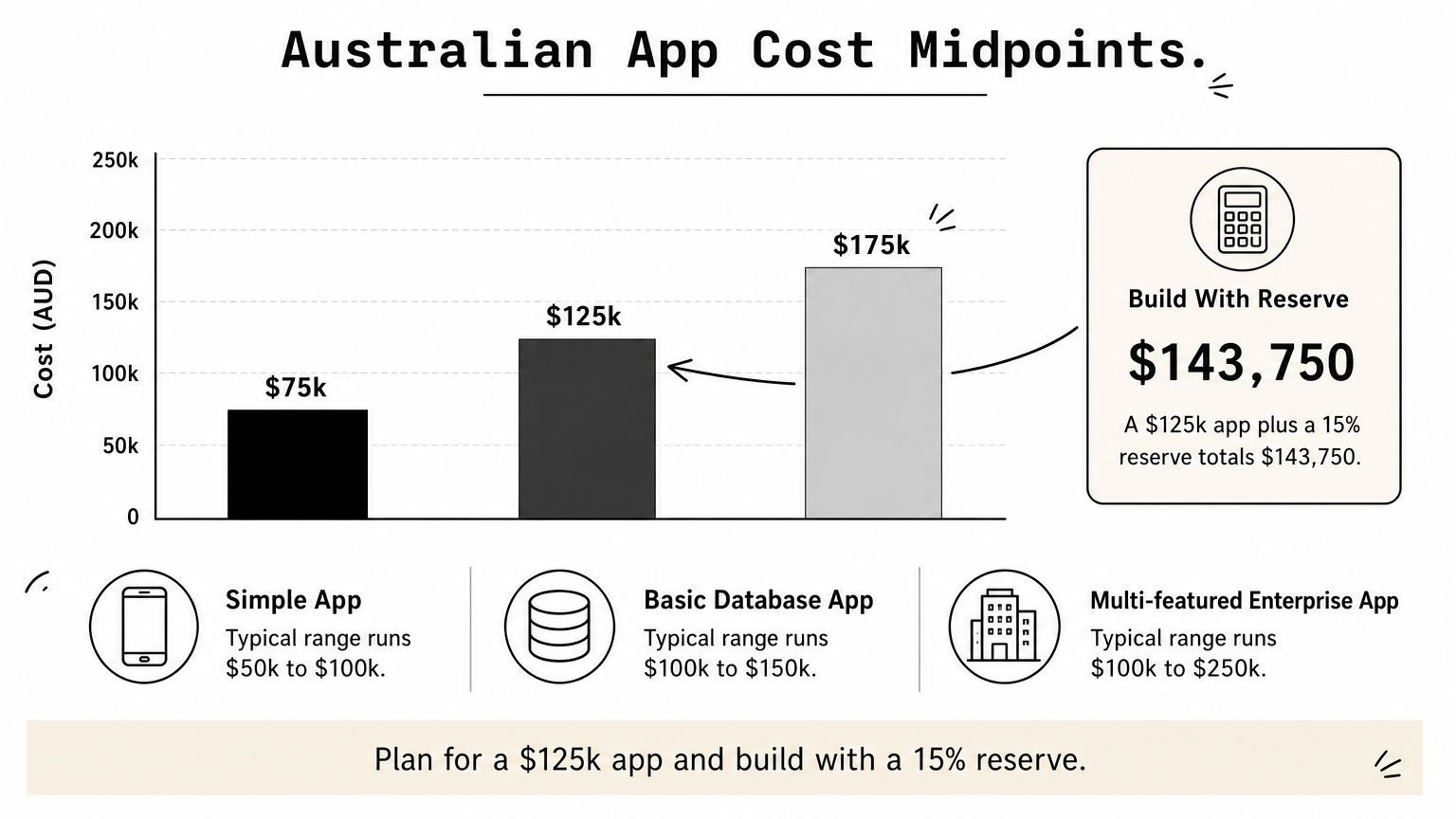
| App type | Typical range | Midpoint |
|---|---|---|
| Simple app | $50k to $100k | $75k |
| Basic database or API app | $100k to $150k | $125k |
| Multi-featured or enterprise app | $100k to $250k | $175k |
The enterprise range starts where the middle tier starts, so complexity, not the label, drives price. Take a basic database app at the $125k midpoint. As a rule of thumb, add a 15% reserve for scope changes, which is $18,750, giving $143,750 for the build. Many teams also budget 15 to 20 percent of the build cost per year for maintenance, which here is $18,750 to $25,000.
Questions to ask before you sign
- Who exactly will work on my app, and can I meet them?
- Can I speak to two recent clients with projects of similar size?
- What does the quote exclude, such as design, backend, testing or store submission?
- Who owns the source code and designs when the project ends?
- How is personal data stored, and does the Privacy Act 1988 apply to my business?
- What does post-launch support cover, and what does it cost per month?
Also ask how they handle App Store approval, since Apple publishes App Store Review Guidelines that rejected apps often fail on.
Put the team, ownership and exclusions in writing before you compare prices.
Picking your shortlist
The right Australian partner depends on your build. Choose a large local studio such as EB Pearls for complex apps, a collaborative studio such as Appetiser or App Boxer for early products, Buzinga for regulated sectors, DigiGround when you want marketing included, and AppGurus when you need stack advice.
Keep your shortlist to two or three companies, ask the same six questions of each, and compare quotes line by line. Add a paid trial or a fixed-scope pilot if the company offers one.
If a lower-cost offshore team with dedicated iOS and Android developers fits your plan, talk to Eagle Technologies about your app and book the free strategy session to test the fit before you commit.