To pick the right partner, write a one-page brief, shortlist four to six companies with proven work in your category, test their technical depth in structured interviews, and compare proposals on a weighted scorecard before paying for a short pilot. That is how to choose the best mobile app development company without relying on a polished sales deck or the lowest quote.
The problem is that almost every agency looks good on paper. Portfolios are curated, testimonials are selected, and quotes for the same idea can differ widely because each company assumed a different scope. A wrong choice costs months, a partial rebuild, or an app that launches and is never updated.
This guide gives you a four-step process you can finish in a few weeks, with the questions to ask, the red flags to watch for, and a scoring table you can reuse. Eagle Technologies builds native iOS, Android, Flutter and React Native apps, so these criteria come from the side of the table that gets evaluated. They work whether or not you ever speak to us.
What to settle before you talk to anyone
Before you contact a single company, settle three things: what version one of the app must do, which platforms it must run on, and what you can spend. Companies can only quote accurately against a brief, and your brief is also your first test of them.
Write a one-page brief
Keep it to one page and cover these points:
- Problem and user: who uses the app and what job it does for them.
- Version one features: three to five must-haves, with everything else on a later list.
- Integrations: payments, login, CRM, ERP, maps, push notifications.
- Platforms: iOS, Android, or both.
- Timeline and budget: a launch window, a spending range, and a reserve for changes and first-year maintenance.
Send the same brief to every company and watch how each one responds. Good companies ask about your users and edge cases. Weak ones send a number within a day.
Decide between native and cross-platform
Native apps (Swift for iOS, Kotlin for Android) suit products that depend on heavy graphics, advanced camera or sensor use, or the newest platform features. Cross-platform frameworks such as Flutter and React Native share one codebase across both platforms, which usually shortens the build for business apps like booking, ordering or internal tools.

You do not have to decide alone, but arrive with a leaning. A company that recommends the same stack for every project is selling its stack, not solving your problem.
A clear brief is your first test: good companies ask questions about it, weak ones just send a number.
Step 1. Build a shortlist of four to six companies
Start with eight to ten names, then cut to four to six using evidence you can check yourself. Fewer than four gives you no basis for comparison, and more than six makes interviews tiring without improving the decision.
Find candidates from several sources
Ask peers who have shipped an app for referrals first, because they will tell you what went wrong as well as what went right. Then open the App Store or Google Play listing of apps you admire. The developer name often leads you to the studio behind it.
Review directories such as Clutch and GoodFirms, plus a plain Google search, add more names. Treat reviews as a filter, not a verdict, since companies can invite only happy clients to write them.
Cut the list with three quick checks
Apply these filters to every name:
- Category fit: at least two shipped apps of similar complexity to yours, not only websites or prototypes.
- Team fit: enough people to cover design, development and QA, so one resignation does not stall your project.
- Time overlap: three to four shared working hours with your day, so questions are answered the same day.
A shortlist should come from evidence you can verify, not from who ranks first on Google.
Step 2. Verify the portfolio and technical depth
Verify the work by using it, and verify the team by asking how it builds. A portfolio page proves a company can write a case study. A live app on your phone proves it can ship.
Use the apps, then call the clients
Download three apps from each shortlisted company. Check the store rating and review count, the date of the last update, and how the app behaves on a slow connection. An app untouched for two years suggests the company walked away after launch.
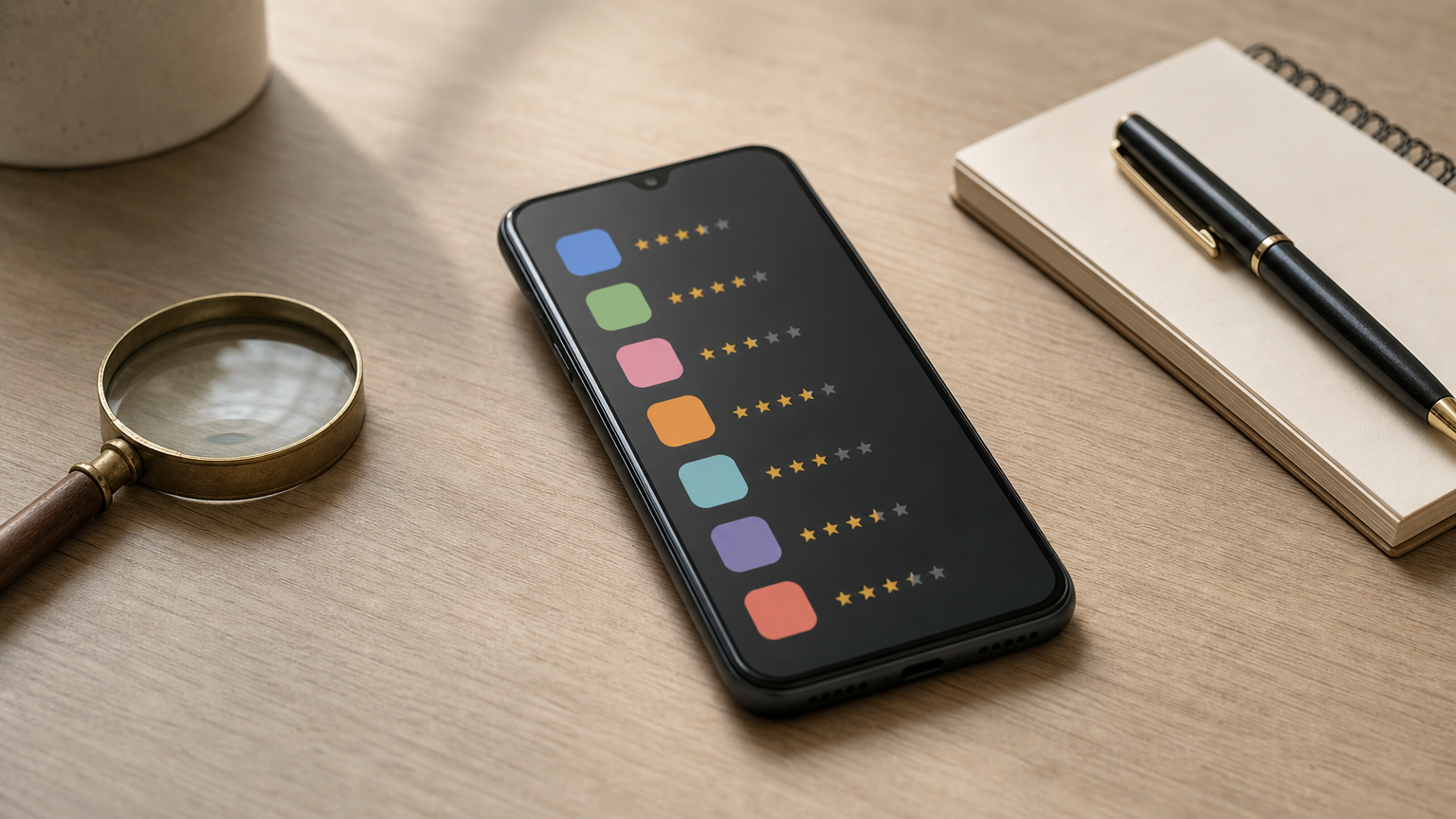
Ask each company for two client references. Then ask those clients whether the project hit its date, how surprises were handled, and whether they would hire the company again.
Probe the engineering
Ask how the team structures, tests and releases code. Listen for specifics: an architecture pattern such as MVVM, automated tests on critical flows, a CI/CD pipeline that builds every change, and crash reporting after launch.
Ask about store review as well. Apple rejects apps that break its App Store Review Guidelines, and an experienced team plans for review instead of discovering it in the final week. Finally, ask where user data is stored, how it is encrypted, and who holds the keys.
A live app on your phone proves more than any case study page.
Step 3. Interview the team and spot red flags
Run one structured interview of 45 to 60 minutes per company, with identical questions each time, and insist that the people who will build your app attend. Identical questions make the answers comparable later.
Questions that separate companies
- Who exactly will work on my app, and what are their roles and experience?
- How do you run discovery before you quote?
- What would you cut from version one to hit my date?
- How do you test, and who signs off on quality before release?
- How often will I see working builds? Two-week sprints with a demo each cycle are a healthy rhythm.
- What happens after launch: bug fixes, OS updates, response times?
- What went wrong on a past project, and what did you change afterwards?
Question seven is the most revealing. A specific, honest answer shows maturity. "Nothing ever went wrong" shows a company that either lacks experience or will not be straight with you.
Red flags to walk away from
Treat each of these as a reason to drop a company:
- A fixed price and date quoted with no discovery.
- No questions about your users or business goals.
- Reluctance to name the people on your team.
- No mention of testing or QA in the proposal.
- Any resistance to handing over source code.
- Pressure to sign quickly for a "limited-time" rate.
Pay attention to what a company asks you, because the quality of its questions predicts the quality of its work.
Step 4. Compare proposals and run a paid pilot
Score every proposal against the same weighted criteria, then confirm your top pick with a short paid pilot before signing the full contract. Never compare quotes on price alone, because the cheapest proposal often leaves out QA, design or post-launch support.
Score proposals side by side
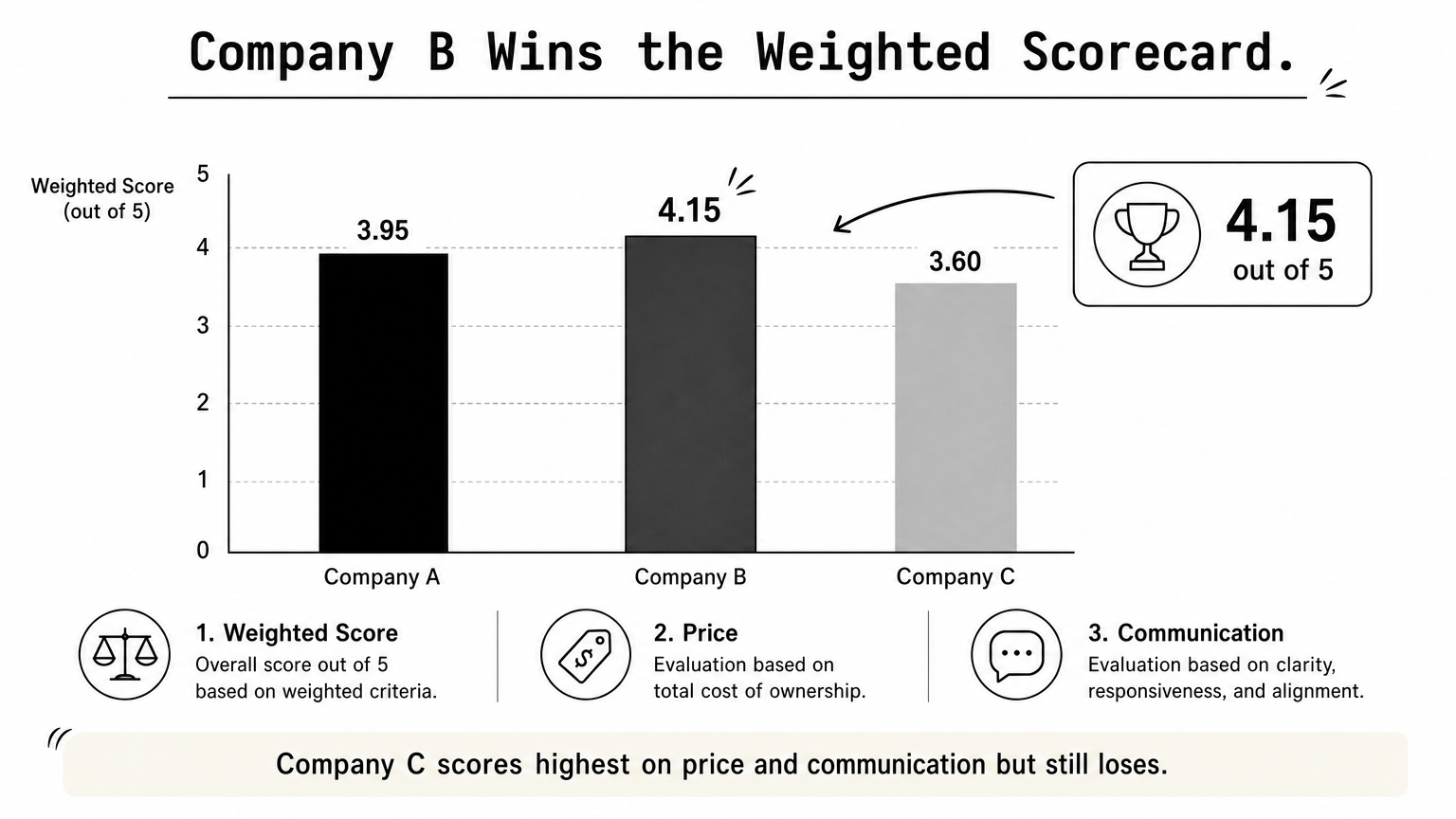
Set your weights before you open any quote, so a low number cannot quietly rewrite your priorities. Score each criterion from 1 to 5. Here is a worked example with three companies:
| Criterion | Weight | Company A | Company B | Company C |
|---|---|---|---|---|
| Relevant portfolio | 25 | 4 | 5 | 3 |
| Technical depth | 20 | 5 | 4 | 3 |
| Communication and process | 20 | 3 | 4 | 5 |
| Price clarity and total cost | 15 | 3 | 4 | 5 |
| Post-launch support | 10 | 4 | 3 | 2 |
| IP and contract terms | 10 | 5 | 4 | 3 |
| Weighted score (out of 5) | 100 | 3.95 | 4.15 | 3.60 |
Multiply each score by its weight, add the results, and divide by 100. Company B wins at 4.15 even though Company C scores highest on price and communication. Compare scope line by line, and note whether each proposal uses fixed price (best for a well-defined scope) or time and materials (better for a product that will evolve).
Lock the terms, then test with a pilot
Before signing, confirm these in writing:
- IP assignment to you, with the source code in a repository you own.
- Apple Developer and Google Play accounts registered in your company's name.
- An NDA, milestone-based payments, and a bug-fix warranty period after launch.
- An exit clause with a full handover.
Then run a pilot: a fixed slice such as the onboarding flow or the design of one critical journey, lasting two to six weeks. Eagle Technologies, for example, usually completes fixed-scope mobile app design pilots within 2 to 6 weeks, and its dedicated iOS and Android developers start with a 2 to 4 week paid trial. Whichever company you choose, ask for the same kind of low-risk start.
Never sign the full contract until you have seen the team deliver one small piece.
Pick on evidence, then prove it
The best mobile app development company for you is the one that passes your tests, not the one with the best pitch. Write the brief, shortlist on verifiable work, interview with identical questions, score proposals on weights you set in advance, and confirm the choice with a paid pilot.
If you want a second opinion on your brief or a proposal you already hold, book a free 60-minute strategy session with Eagle Technologies. We will review your marketing, tech stack and growth blockers with no obligation, and you can run the same scorecard on us.