Website design cost in India is the total you pay to plan, design, build and launch a site, and for most small businesses it falls between ₹10,000 and ₹150,000. A template-based site with five to eight pages sits at the low end. A larger business site, a custom design or an online store pushes the figure to ₹75,000 to ₹500,000 (5 lakh), and custom web applications start around ₹200,000. One lakh is 100,000 rupees, and every figure below is in INR unless stated.
The wide spread is the real problem. Two agencies can quote ₹15,000 and ₹150,000 for what looks like the same site, and both can be honest. This guide explains what drives that gap and shows how to build your own estimate, with a worked example. It then sets out price ranges by site type, by who builds the site, and for the running costs that arrive after launch. It closes with a way to compare quotes and a look at what fixed-price packages include.
Eagle Technologies builds websites from a delivery centre in Jaipur, with headquarters in South Africa, so the ranges are framed the way agencies scope real projects. Where published Indian price guides disagree, the figures below show the overlap instead of picking one number.
Why website design cost in India varies so much
Website design cost in India varies because the word "website" covers jobs that differ enormously in effort. A one-page landing page on a template takes a day or two. An online store with payments, inventory and shipping rules takes weeks or months. The price follows the work involved, not the label.
Six factors set the price
Six factors explain most of the gap between a low and a high quote. Scope and design approach do the most damage to a budget, because each one multiplies the hours behind everything else.
| Factor | Lower cost | Higher cost |
|---|---|---|
| Pages | 1 to 8 | 25 to 75 |
| Design | Template with your logo and colors | Custom UI/UX built from wireframes |
| Features | Contact form | Payments, logins, booking, search |
| Content | You supply text and photos | Professional writing and photography |
| Integrations | None | CRM, ERP, payment gateways, APIs |
| Builder | DIY tool or freelancer | Agency team with design, development and QA |
Most buyers underestimate the content row. A site is not finished when the design is approved, because someone still has to write and edit every page.
Why two quotes for the same site can differ tenfold
The difference usually hides in what each quote includes. A ₹15,000 quote typically covers a pre-built theme, your own text and a small number of revisions. A ₹150,000 quote usually adds discovery and wireframes, a custom layout, written content, speed work, testing and project management. Neither is dishonest. They sell different products under the same name.
Ask each provider the same five questions. How many pages are included, who writes the text, how many revision rounds do you get, what happens after launch, and who owns the files and the domain? Answers to those five questions explain most price gaps within ten minutes.
A low quote and a high quote are rarely for the same website, so compare what is included before you compare the totals.
Why India costs less than the US or UK
India is cheaper because salaries and overheads are lower, not because the work is simpler. Agencies in the US and Europe commonly charge several times more for comparable scope, which is why many overseas companies hire Indian teams for design and development. The same hours simply cost less.
Lower prices do not mean lower quality, and high prices do not guarantee it. Quality depends on the seniority of the people on your project and on the team's process. Judge a provider by its past work and how clearly it explains what you get, not by whether it is cheap or expensive for its city.
How to estimate your website cost in India
To estimate your website cost in India, list what the site must do, choose a build approach, price the recurring items, then add GST and a buffer. It takes about an hour and gives you a number to test every quote against.
Five steps to a working budget
Work through these steps in order, and write each number down as you go.
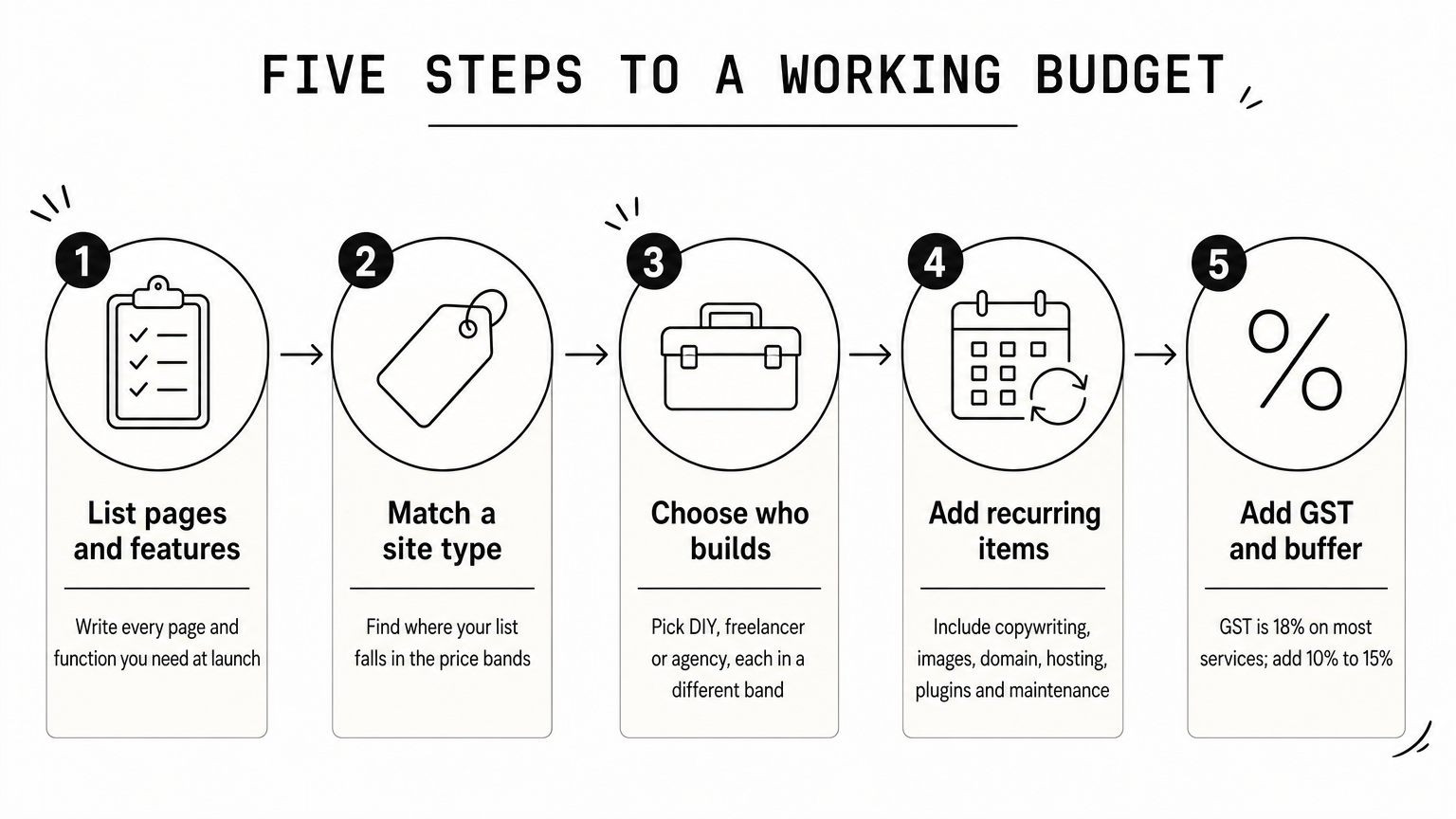
- List the pages and features. Write every page you need at launch and every function, such as a contact form, WhatsApp button, payments, blog or booking.
- Match the list to a site type. The next section gives the price band for each type, so you can see where your list falls.
- Choose who builds it. A DIY builder, a freelancer and an agency sit in very different price bands, covered further down.
- Add content and recurring items. Include copywriting, images, a logo, the domain, hosting, premium plugins and maintenance.
- Add GST and a buffer. GST is 18% on most IT and design services. Small freelancers below the registration threshold may not charge it. Add 10% to 15% on top for scope changes.
The buffer matters more than it looks. Most budgets break because a client adds a page or a feature midway, not because a quote was wrong.
Worked example: a 10-page small business site
Take a service business that wants a 10-page WordPress site, built by a small agency on a customized theme. The business asks the agency to write the content and design a simple logo. The table uses mid-range figures from the sections that follow.
| Item | Amount |
|---|---|
| Design and build, 10 pages | ₹60,000 |
| Content writing, 10 pages at ₹3,000 | ₹30,000 |
| Logo design | ₹3,000 |
| Premium plugins | ₹5,000 |
| Domain, one year | ₹1,000 |
| Shared hosting, one year | ₹5,000 |
| Subtotal | ₹104,000 |
| GST at 18% on the subtotal | ₹18,720 |
| Year-one total | ₹122,720 |
The year-one total is about ₹1.23 lakh. Treat the GST line as an upper bound, since not every vendor charges it on every item.
From year two, the running cost is the domain (₹1,000), hosting (₹5,000) and maintenance. Using a common rule of thumb of 15% to 20% of the build fee per year, maintenance is ₹9,000 to ₹12,000. That makes ₹15,000 to ₹18,000 a year, or roughly ₹1,250 to ₹1,500 a month, before GST. SEO and ad spend are separate.
What to do when the estimate is too high
When the total overshoots, cut scope before you cut quality. Launch with fewer pages and add the rest later, since a five-page site can go live and grow. Cutting the example from ten pages to five and writing the text yourself removes the ₹30,000 content line entirely and shrinks the build fee.
You can also move from a custom layout to a well-built template, or delay features such as booking or a blog until the first version earns revenue. Each of these choices lowers the price without touching the parts visitors judge first, which are speed, clarity and mobile layout.
A website budget is a list of choices, and every line on it can be cut, delayed or done yourself.
Website cost in India by type of site
A basic business site costs ₹10,000 to ₹40,000, a larger small-business site ₹25,000 to ₹150,000, an e-commerce store ₹75,000 to ₹500,000, and a custom web application from ₹200,000. Published price guides overlap more than they agree, so these bands blend them. They also stay wide because a template build and a custom build of the same site type differ in price by several times.
| Site type | Typical scope | Typical cost |
|---|---|---|
| Landing page or one-page site | 1 page, form, simple styling | ₹5,000 to ₹25,000 |
| Basic business site | 5 to 8 pages on a template | ₹10,000 to ₹40,000 |
| Small business site | 10 to 20 pages, blog, custom elements | ₹25,000 to ₹150,000 |
| Corporate or large site | 25 to 75 pages, custom design | ₹100,000 to ₹300,000 |
| E-commerce store | 50 to 1,000+ products, payments, shipping | ₹75,000 to ₹500,000 |
| Custom web application | Logins, databases, integrations | ₹200,000 to ₹500,000+ |
Landing pages and basic business sites
A one-page site is the cheapest serious option, usually ₹5,000 to ₹25,000. It suits a freelancer, an event or a new business that needs a presence fast. Everything sits on one scrolling page, which also works well on phones.
Packages advertised at a few thousand rupees do exist. They are normally fixed templates with a domain and hosting bundled for the first year, and they limit revisions. A basic five to eight page business site with a customized template and basic SEO setup typically lands at ₹10,000 to ₹40,000. That is enough for a local business that needs services, an about page and contact details.
Small business and corporate sites
Once a site passes ten pages, with a blog, service pages, a gallery or a FAQ, you are in the ₹25,000 to ₹150,000 band. The low end means a customized template. The high end means custom layouts, richer features and often written content. Typical pages at this size are about, services, products, FAQ, testimonials, contact and blog.
Corporate sites with 25 to 75 pages, several audiences and custom design run ₹100,000 to ₹300,000. Page count alone misleads here. A home page and a product template take far longer than a contact page, so a quote should break out the unique templates, not just count pages.
E-commerce stores
Online stores are the most variable category, at ₹75,000 to ₹500,000. A small store with 50 to 100 products on a platform such as Shopify or WooCommerce sits near ₹75,000 to ₹150,000. Stores with thousands of products, several payment gateways and custom features reach ₹350,000 or more.

Four things move the price. The number of products and variants, the payment methods you support (UPI, cards and net banking are the usual Indian options), shipping and courier integrations, and GST-ready invoicing. Add inventory sync or a marketplace connection and the cost rises again.
Custom web applications
A custom web application, such as a customer portal, a booking system or a calculator, starts around ₹200,000 and can pass ₹500,000. You are paying for custom database design, user accounts and permissions, and integration with other business software. It only makes sense when a template or plugin cannot do the job.
Scope decides the price band, and page count alone tells you very little.
Freelancer, agency or DIY builder: cost compared
A DIY builder costs the least in cash, a freelancer typically charges ₹5,000 to ₹30,000 for a small site, and an agency starts around ₹15,000 for template work and exceeds ₹500,000 for fully custom builds. You choose how much time, risk and customization you want to pay for.
Typical cost by build approach
The cost of website development in India splits cleanly by approach, and each step up buys more customization and more people on your project.
| Approach | Typical cost | Best for |
|---|---|---|
| DIY website builder | Monthly plan plus domain, and your own time | Tiny businesses and freelancers testing an idea |
| Freelance designer | ₹5,000 to ₹30,000 per small site, or ₹1,000 to ₹3,000 per hour | Simple sites on a template |
| Template-based agency build | ₹15,000 to ₹75,000 | Standard needs, fast launch |
| Semi-custom agency build | ₹75,000 to ₹200,000 | Growing businesses that need tailored layouts and features |
| Fully custom build | ₹200,000 to ₹500,000+ | Unique processes and complex integrations |
When a DIY builder or freelancer is enough
A DIY builder is enough when the site is small and your needs are standard. You pick a template, add your text and photos and publish. The price is a monthly plan fee plus a domain, and the cost you do not see is your own time. It gets difficult when you need features the builder does not offer or integrations with outside tools.
A freelancer is the middle path. At ₹1,500 an hour, a 20-hour site costs ₹30,000, and many small jobs finish for less. The risk is dependence on one person. If your freelancer is unavailable or leaves, you need someone else to understand the build. Ask for the source files and admin access at handover.
When an agency earns its higher price
An agency costs more because it staffs a designer, a developer, a tester and a project manager. You pay for continuity and for a process that survives one person being unavailable. That matters most for e-commerce, integrations, multi-language sites and anything tied to revenue.
Fixed scope is the other reason to use one. Reputable agencies agree on deliverables, revision rounds and timeline before work starts, which protects your budget from open-ended hours. If the site is a five-page brochure, an agency is probably more than you need.
Pay for custom work only when a template cannot do the job you need done.
Running costs that come after launch
Running a small site costs about ₹15,000 to ₹35,000 a year for the domain, hosting and maintenance, before content and SEO. Build cost is a one-time figure, but website creation cost in practice includes a yearly bill that many first-time buyers forget.
Domain, hosting and SSL
These three are the cheapest and most predictable items. A .com or .in domain usually costs ₹800 to ₹1,500 a year, though premium names cost more. Hosting is the part that grows with your traffic.

| Item | Typical cost | Notes |
|---|---|---|
| Domain (.com, .in) | ₹800 to ₹1,500 per year | Premium or short names cost more |
| Shared hosting | ₹1,000 to ₹8,000 per year | Fine for small sites and low traffic |
| VPS hosting | ₹12,000 to ₹30,000 per year | Faster and more isolated, for busier sites |
| Cloud hosting | ₹30,000 to ₹100,000+ per year | For heavy or unpredictable traffic |
| SSL certificate | Often free with hosting | Paid certificates run up to about ₹5,000 per year |
Most small business sites run well on shared hosting or a small VPS. Register the domain in your own name, so you keep control if you change provider.
Maintenance and updates
Maintenance covers software and plugin updates, security patches, backups, uptime checks and small content edits. Budget 15% to 20% of the build cost per year. On a ₹100,000 site that is ₹15,000 to ₹20,000, or about ₹1,250 to ₹1,670 a month.
Retainers priced by the month are the alternative. Informational sites usually run ₹2,000 to ₹5,000 a month. Stores that need constant plugin updates, patches and monitoring can reach ₹20,000 to ₹25,000 a month. Skipping maintenance saves money for a year or two. Then a hacked or broken site costs far more to fix.
Content, SEO and add-ons
These items are optional on day one, but most sites need them within months.
- Content writing: about ₹2,000 to ₹4,000 per page, or ₹1 to ₹3 per word depending on experience.
- SEO: freelancers charge up to about ₹8,000 a month, and agencies ₹15,000 to ₹30,000 a month. Results usually take several months to show.
- Logo design: ₹1,500 to ₹5,000 for a straightforward logo.
- Premium plugins: ₹1,000 to ₹10,000 each, depending on the feature.
- Email newsletter tool: around ₹1,000 a month for a small list.
Do not buy everything at launch. A site with sound content and a working contact form earns more than one with five paid plugins that nobody configured.
Domain and hosting are cheap, while the real running cost is the human time spent maintaining, writing and marketing the site.
How to compare quotes and avoid overpaying
Compare quotes line by line on deliverables, not on the total at the bottom. Ask three providers for a written quote on the same list of pages and features, and the differences become obvious within one reading.
What a good quote lists
A useful quote reads like a checklist. Look for each of these items stated in writing.
- The number of pages and the number of unique page templates
- Template or custom design, and whether you see wireframes first
- Mobile-responsive layout and basic on-page SEO
- Who writes the text, and who supplies images
- Revision rounds included, and the price of extra rounds
- Domain, hosting and SSL: who buys them, in whose name, and for how long
- Timeline, payment milestones and handover (admin access, source files, a short training session)
- GST, shown separately
A provider that cannot fill in these lines has not scoped your project yet. Payment milestones tied to delivered work are also a good sign. Full payment upfront is a warning.
Red flags in very cheap packages
A package priced at a few thousand rupees is not automatically a scam, but read the terms. Watch for a "free" domain and hosting that renew at full price after year one, and a fixed template shared with other customers. Check for hard limits on revisions and a charge for every extra page.
Also confirm that you receive ownership of the site and the domain. If the provider holds the hosting account and the domain in its own name, moving later becomes a negotiation. A cheap site that you cannot move is expensive in the long run.
Ways to lower the cost without hurting quality
Several choices reduce the price with little visible loss. Supply your own content and photos, since writing is often a third of the total. Start with a template, and plan a custom redesign once the business grows. Launch with the pages that earn enquiries, and add the blog and extra services later. Finally, decide which features are essential. A contact form and a WhatsApp button capture most small business leads without any custom development.
Judge a quote by what it lists, and be wary of any that lists too little.
What fixed-price website packages include
A fixed-price package bundles a defined scope at a set price, which makes the cost predictable. Eagle Technologies publishes three website design packages, and they show how scope scales with price. Treat them as a worked reference for what each level of spend can include.
Three tiers and what each covers
| Package | Price | What it includes |
|---|---|---|
| Launch | $499 one-time | Up to 5 responsive pages, Next.js or WordPress build, basic on-page SEO, contact form and WhatsApp button, speed optimization and QA, deployment support |
| Growth | $999 one-time | Up to 12 pages with a conversion-focused layout, blog or case-study module, advanced schema and technical SEO, CRM or email tool integration, analytics and event tracking |
| Scale | $1,999+ per project | Custom UI/UX and design system, multi-language and multi-region architecture, headless CMS or custom admin panel, performance and security hardening, CI/CD, dedicated delivery lead |
Launch targets startups and local businesses, Growth targets small and mid-sized businesses scaling lead generation, and Scale targets enterprise-grade sites. Online stores are scoped separately, because platform, catalogue size and payment setup decide the price.
How these prices compare with the market ranges
Prices are in US dollars, so convert at the day's exchange rate. At an assumed ₹85 to ₹90 per dollar, Launch is roughly ₹42,000 to ₹45,000, Growth roughly ₹85,000 to ₹90,000, and Scale from roughly ₹170,000.
Those figures line up with the bands above. Launch sits at the upper edge of a basic business site, because it includes QA, SEO setup and lead capture. Growth falls inside the small business band. Scale starts inside the corporate band and runs into custom territory. The pattern holds for any provider: price rises with pages, integrations and custom design, not with the label on the package.
Questions to ask about any package
Before you sign, ask what the price leaves out. Confirm whether hosting and the domain are included and in whose name. Ask who writes the copy, how many revision rounds apply, and what maintenance costs after launch.
Ask about contract terms too. Eagle Technologies states that it has no hidden costs and no contract lock-ins, and it can invoice in INR or ZAR. Hold any provider to the same standard by asking for those terms in the proposal.
A package price is only useful when you know what it includes, what it excludes and who owns the result.
Set a budget, then get a scoped quote
Website design cost in India depends on four things you control: the number of pages, template or custom design, who builds it, and how much you hand over to professionals for content and upkeep. Most small businesses spend ₹25,000 to ₹150,000 to launch, then ₹15,000 to ₹35,000 a year to keep the site running. Stores and custom applications cost more, and the work behind those higher prices is real.
Start with your page and feature list, run the five-step estimate, and ask for written quotes that list deliverables. If you want a second opinion on scope or a price for your own project, ask Eagle Technologies for a scoped quote and bring your list.