The best mobile app development company UK buyers can hire is the one with shipped apps in your sector, security credentials you can verify, and a pricing and ownership model you understand before you sign. Of the eight agencies below, The Distance suits planning-led projects, Coreblue suits buyers who need ISO and Cyber Essentials paperwork, and Corporation Pop suits health, education and AR work. Eagle Technologies suits teams that want dedicated iOS or Android developers at offshore rates with UK-friendly hours. The rest fit specific sectors, covered below.
Choosing is hard because every agency's website makes the same promises: scalable, secure, user-first. Portfolios are partly hidden behind NDAs, price lists are rare, and quotes for one brief can sit far apart. You end up with a dozen browser tabs and no clear way to compare studios in London with studios in Plymouth, York or Edinburgh, or with teams outside the UK.
This guide gives you eight agencies in the same format, so you can compare like with like. After the list you get a side-by-side table, UK cost and timeline ranges, a worked budget example, and a hiring checklist. One disclosure: Eagle Technologies publishes this blog, so it is listed first. It is not a UK studio. Its headquarters are in South Africa and its delivery centre is in Jaipur, India, and we say plainly where that helps and where it does not. Agency details come from public websites and portfolios, so confirm current details on a call.
1. Eagle Technologies
What they do
Eagle Technologies builds native iOS and Android apps and cross-platform apps in Flutter and React Native. It also offers mobile app design and UI/UX work in Figma. It was founded in 2012 and works from a headquarters in South Africa and a delivery centre in Jaipur. It has no UK office, so treat it as an offshore option rather than a local studio.
- Founded: 2012
- Headquarters: South Africa, with delivery in Jaipur, India
- Services: native iOS, native Android, Flutter, React Native, mobile app design, UI/UX
- Team: 50+ specialists
Where they stand out
Flexibility of engagement is the main strength. You can commission a full project, or you can hire dedicated developers. iOS developers work in Swift, SwiftUI, Xcode and CoreData. Android developers work in Kotlin, Jetpack Compose and Material 3. Engagement is hourly, part-time or full-time, developers start within 3 to 7 business days, and a 2 to 4 week paid trial lets you test the fit before committing.
The process is light. A free 60-minute strategy session comes first, then work runs in two-week sprints with weekly reporting. Eagle states it has no hidden costs and no contract lock-ins. Contracts are NDA-ready, and IP assignment terms are available so you own what gets built. Developer hours in IST overlap with UK mornings and afternoons, which keeps stand-ups practical.
Who they suit
Eagle fits UK product companies, digital agencies and in-house IT teams that need extra mobile capacity or a cost-conscious build and are comfortable running a remote engagement. It is a weaker fit if you want in-person workshops in your own city.
Ask these before you sign:
- Eagle invoices in INR or ZAR, so ask how that translates into a pound budget.
- Ask who carries UK GDPR responsibilities in the contract.
- Ask who the senior lead is that reviews each deliverable.
Offshore delivery earns its place when you want developer capacity and sprint discipline, not a studio down the road.
2. The Distance
What they do
The Distance is a London-headquartered studio, founded in 2009, with offices in London and York. It builds mobile apps without tying itself to one operating system, and it has a particular Android specialism. Its services are mobile app development, UI/UX design and digital strategy.
- Founded: 2009
- Base: London and York
- Sectors named: education, healthcare, travel, transportation, finance
Where they stand out
The studio describes a working method called The Core. According to its own website, this phase completes roughly 20 to 30 percent of a project before the first line of code is written. Think of it as paid planning, prototyping and de-risking, which suits buyers who have been burned by vague scopes.
Its portfolio is easy to evaluate. Each success story sets out the brief, the solution and the result. Named work includes iPrescribe Exercise, Good Shape, KodyPay and PayStream, along with projects for Mitsubishi and Bentley. That mix of health, payments and automotive shows range.
Who they suit
The Distance suits mid-sized and larger organisations in health, education, travel, transport and finance. These are buyers who want strategy and design finished before build begins, and who would rather pay for clarity upfront than discover scope gaps in month three.
Confirm how the planning phase is priced and what you keep if you stop after it. Also ask whether your app's platform mix (iOS-first, Android-first or both) matches the team you would actually get.
A planning-led studio costs more before launch day and usually less after it.
3. Coreblue
What they do
Coreblue is a Plymouth-based product studio founded in 2016. It is led by CEO Lewis Boyles-White, CTO Dan Hardman and COO Olly Harrison. It offers mobile and software development plus product and design work.
- Founded: 2016
- Base: Plymouth
- Certifications: ISO 9001, ISO 27001, Cyber Essentials
- Sectors named: finance, travel, non-profit
- Projects: 50+ delivered
Where they stand out
The certification stack is the headline. ISO 27001 and Cyber Essentials matter if your procurement team sends security questionnaires, because they let you answer many of the questions with a certificate rather than a promise.
Coreblue also handles messy starting points. It improves existing prototypes, modernises legacy systems and builds from scratch. Its case studies cover Go Volunteering, Ama Selections, The Cruising Association and Bank of Kigali, each written as an overview, a challenge and the solution.
Who they suit
Coreblue fits finance, travel and charity organisations, and any buyer who needs to hand a supplier file to a compliance team. It also suits businesses with a half-built app that needs a rescue rather than a restart.
Check that the certification scope covers the people who would work on your app. Ask for a recent reference in your sector, since the portfolio spans quite different clients.
A certificate does not build your app, but it shortens the security review that can stall it.
4. Corporation Pop
What they do

Corporation Pop is a Manchester agency founded in 1991, which makes it one of the longest-running names here. It builds mobile apps and web products, and adds UI/UX design and branding. It has worked with NHS organisations, universities, TV channels and charities.
- Founded: 1991
- Base: Manchester
- Sectors named: healthcare, entertainment, gaming
Where they stand out
Its distinctive territory is AR and interactive work. Roadbot is an AR app that teaches children road safety rules. Other projects include the Good Employment Charter, Fantasia Express and Xploro. Few agencies here can show comparable AR work.
It also won the digital innovation award at Venturefest in 2018. References from the Manchester University NHS Foundation Trust and the University of Bradford praise its flexibility with different management approaches. Public sector buyers often care about that more than a polished pitch.
Who they suit
Corporation Pop suits NHS bodies, universities, charities and media or education brands that want something more interactive than a standard utility app. It also suits teams whose stakeholders change often and need a supplier that adapts.
Because the award is from 2018, ask for recent case studies and the current team's experience. Confirm whether AR is part of your scope. If it is not, check that its general app delivery matches your needs.
For interactive, public-facing apps, a studio with thirty years of client variety brings habits that younger shops lack.
5. Sonin
What they do
Sonin is a Surrey agency founded in 2008. It concentrates on mobile app engineering, system integration, and support and maintenance. That trio covers the build, the connection to your existing software, and the years after launch.
- Founded: 2008
- Base: Surrey
- Sectors named: healthcare, education, construction, property, logistics
Where they stand out
Sonin's pitch is close partnership and integration. Mobile apps for operations usually fail at the seams, where the app has to talk to a CRM, ERP or booking system. A studio that lists system integration as a core service has thought about that.
It lists several awards, including the UK App Award, a Digital Impact Award and a Health Tech Award. Client work includes a customer support app for Watco, plus projects for OpenAir Med, TravelHers, LandTech, Scape and Belle Hutt. Those clients span health, travel and property.
Who they suit
Sonin fits businesses in construction, property, logistics, health and education that need an app wired into existing systems and kept current afterwards. It is a sensible choice when the mobile app is one part of a larger operational workflow.
Ask which integrations it has built before, and whether support is a retainer or time-and-materials. Also ask how it handles OS updates, since every autumn brings new iOS and Android versions.
Most operational apps live or die on integration, not on screens.
6. Thumbmunkeys
What they do
Thumbmunkeys is a York studio founded in 2012 by Mark Bryan and Stefan Repauer, who started it in a kitchen. It has grown to more than 30 employees and has built about 50 systems for phones and laptops over the past decade. Services are mobile and web development, UI/UX design, and support and maintenance.
- Founded: 2012
- Base: York
- Sectors named: medicine, property, transportation, finance
- Compliance claims: GDPR compliant, ISO 27001 and ISO 9001 conformity
Where they stand out
Thumbmunkeys runs its own consumer apps, including Visibeat, Phototastic Collage and iDrillsafe. A studio that ships and maintains products under its own name understands App Store reviews, ratings and update cycles first-hand, which is useful when you hire a team for the same job.
Client work includes a Transport for London payments project and an app for Abingdon Health that lets users see their medical test results. It has also worked with charity clients such as Fishpass and the Bumblebee Conservation Trust. That is a credible spread across transport, health and non-profit work.
Who they suit
Thumbmunkeys suits small and mid-sized organisations in health, property, transport and finance that want a mid-sized team rather than a large agency, and that value having the founders' attention.
Since compliance is part of the pitch, ask to see current certificates and their scope rather than relying on the website. Also ask how its team of 30+ would be allocated to your project.
A studio that publishes its own apps has already made the mistakes you would pay for.
7. Zudu
What they do
Zudu is an Edinburgh agency founded in 2011 and led by CEO James Buchan. It builds mobile and web applications, integrates AI features and delivers MVPs. It reports more than 300 projects across sectors, including strictly regulated ones.
- Founded: 2011
- Base: Edinburgh
- Sectors named: energy, healthcare, finance, public sector
Where they stand out
Zudu's recognition is varied. It was named a BMA platinum winner in 2022, received a Web Excellence Award, and is listed with the Digital Poverty Alliance. Awards are marketing, but a health-sector prize in particular suggests it can work under clinical scrutiny.
Its project write-ups include concrete usage numbers. Triptix, a web and mobile venture, is used by more than 80,000 people. Moblyze, a recent app for hiring specialists in the energy sector, reports an 80 percent active user rate. Usage figures are more useful than download counts because they show whether people kept using the app.
Who they suit
Zudu suits energy, health, finance and public sector buyers, and founders who want an MVP built quickly with the option of AI features later. Its Edinburgh base makes it a natural choice for Scottish organisations that prefer to meet in person.
Ask which of the 300+ projects were mobile-first, and for a reference from a regulated client. Confirm how it scopes an MVP so the first release stays small.
Usage figures such as active user rate say more about an agency than download counts do.
8. Foresight Mobile
What they do
Foresight Mobile is a Manchester studio founded in 2016 by Gareth Reese, a developer with more than 20 years in the industry. It covers iOS and Android engineering from the first idea through to support, and it also offers ongoing maintenance.
- Founded: 2016
- Base: Manchester
- Sectors named: sport, retail, logistics, sustainability, IoT
Where they stand out
The standout is a CTO-as-a-service option for startups. If you are a non-technical founder, an experienced technical lead can guide product decisions, hiring and architecture while the studio builds. That is rare among app agencies and addresses the most common founder gap.
Its portfolio covers sport, retail and other sectors where apps need continued feature development and cross-platform programming. The IoT experience also matters if your app must talk to hardware, sensors or connected devices.
Who they suit
Foresight Mobile suits early-stage founders who need technical leadership as well as developers, and established brands in sport, retail and logistics that want a long-term product team rather than a one-off build.
Ask how the CTO service is priced and where it ends, so advice does not quietly turn into dependency. Also ask which projects were built for IoT if that is relevant to you.
If you cannot judge a technical proposal yourself, hire the judgement before you hire the code.
How the eight agencies compare at a glance
The table puts the eight side by side on the facts that most affect a shortlist: where the team sits, how long it has been trading, and what it is known for. It does not rank them, because the right choice depends on your sector, budget and how much hands-on involvement you want.
| Agency | Base | Founded | Known for | Sectors named |
|---|---|---|---|---|
| Eagle Technologies | South Africa HQ, Jaipur delivery | 2012 | Dedicated iOS and Android developers, cross-platform builds | Product companies, agencies, startups, enterprises |
| The Distance | London, York | 2009 | Planning-led process, Android | Education, healthcare, travel, transport, finance |
| Coreblue | Plymouth | 2016 | ISO 9001, ISO 27001, Cyber Essentials | Finance, travel, non-profit |
| Corporation Pop | Manchester | 1991 | AR and public sector work | Healthcare, entertainment, gaming |
| Sonin | Surrey | 2008 | Integration and support | Healthcare, education, construction, property, logistics |
| Thumbmunkeys | York | 2012 | Own consumer apps | Medicine, property, transport, finance |
| Zudu | Edinburgh | 2011 | Regulated sectors, MVPs, AI features | Energy, healthcare, finance, public sector |
| Foresight Mobile | Manchester | 2016 | CTO-as-a-service | Sport, retail, logistics, sustainability, IoT |
Local studio or offshore team
A UK studio gives you the same time zone, UK contract law, and the option to meet at your office or theirs. That matters most during discovery and design, when the conversation is fast and loose. You pay for it in day rates, which are usually higher than offshore.

An offshore team like Eagle Technologies trades face-to-face access for lower cost and extra capacity. The IST working day overlaps with UK mornings and afternoons, so daily stand-ups work, and most build work does not need anyone in the room. A hybrid is common: run discovery and design with a local partner, then hand the build to a remote team.
Proof to weigh beyond the table
The table cannot show how well an agency delivers, so look for evidence in this order:
- Case studies that state a result, such as active users or processing time saved, not just a screenshot.
- Certificates you can ask to see, with their scope.
- A reference you can phone, in your sector, from the last two years.
- Company age. Longevity does not prove quality, but a studio that has traded since 1991 or 2008 has survived several platform shifts.
A shortlist works best when it mixes at least one local studio and one cost-led alternative, so quotes have something to be compared against.
What a UK mobile app costs and how long it takes
Most UK agencies publish ranges that start around £11,000 for a lean MVP and run past £300,000 for enterprise builds, with timelines from about six weeks to two years. The spread is wide because "an app" can mean a booking tool or a regulated banking platform. Use the tables below to place your project, then get quotes against a written scope.
Cost ranges by scope and platform
Published figures from UK studios disagree, so the bands below combine them. Treat them as planning ranges, not quotes.
| App scope | Typical cost | Typical timeline |
|---|---|---|
| Simple app or MVP | £11,000 to £60,000 | 6 weeks to 5 months |
| Mid-complexity app | £18,000 to £140,000 | 10 weeks to 12 months |
| Complex or enterprise app | £110,000 to £300,000+ | 20 weeks to 24+ months |
Apps with AI, IoT or blockchain features commonly start around £150,000. The platform you pick also changes the bill:
| Platform | Basic build | Advanced build |
|---|---|---|
| Native iOS | £15,000 to £40,000 | £100,000 to £300,000 |
| Native Android | £10,000 to £35,000 | £80,000 to £250,000 |
| Cross-platform | £20,000 to £50,000 | £100,000 to £300,000 |
Hourly rates and a worked example
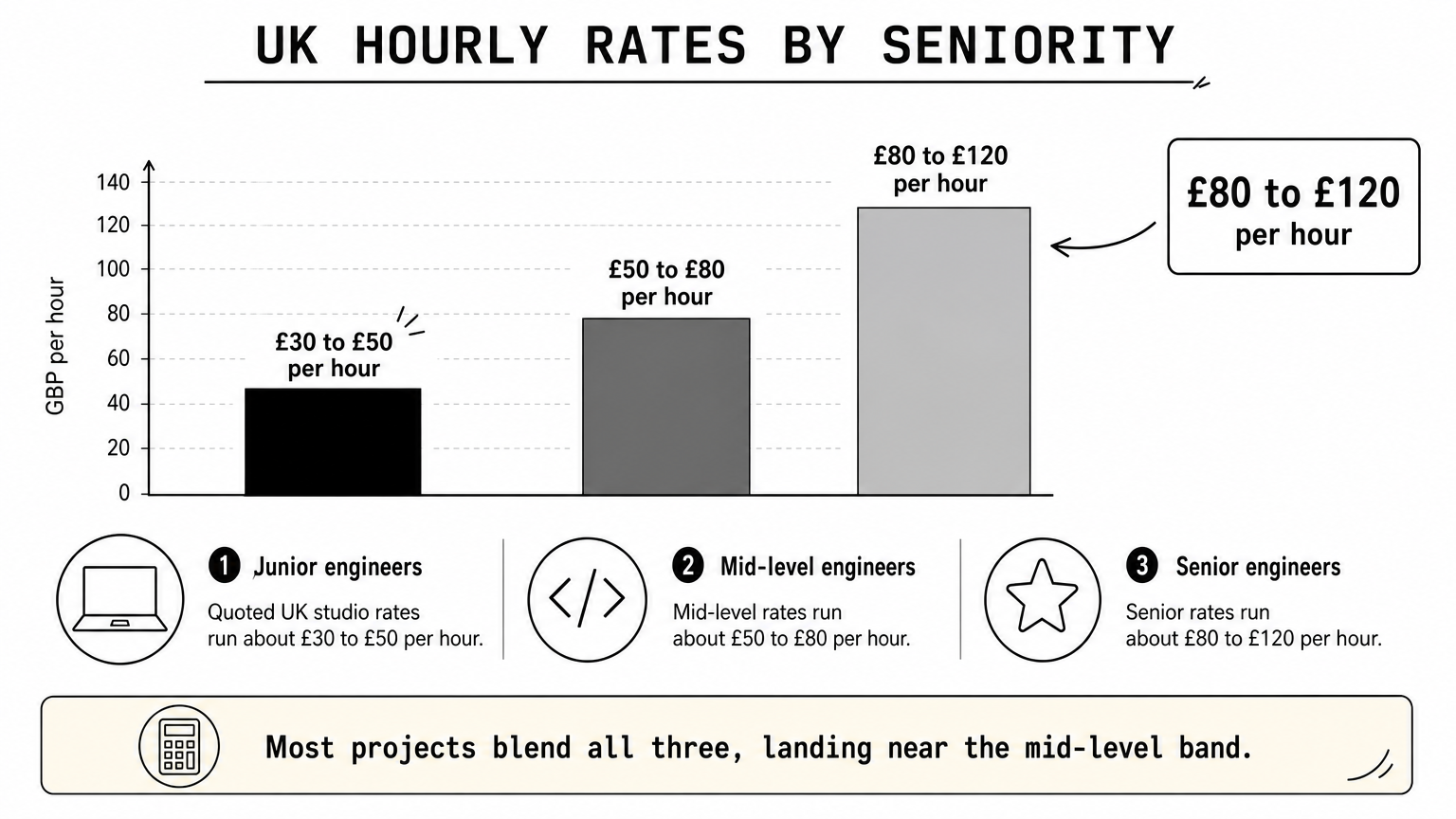
Hourly rates quoted by UK studios run about £30 to £50 for juniors, £50 to £80 for mid-level engineers and £80 to £120 for seniors. Most projects blend all three, so your effective rate usually lands near the mid-level band.
Here is a worked example for a cross-platform booking app with login, payments and a simple admin panel. Assume 600 hours at a blended £65 per hour, which gives £39,000. Add a 15 to 20 percent buffer for change requests and testing, which is £5,850 to £7,800. Your realistic budget is £44,850 to £46,800, so plan on roughly £45,000. That sits inside the cross-platform basic band above.
Also budget for what the quote often leaves out. Apple's developer programme costs $99 a year and a Google Play developer account is a one-time $25. Ask whether quotes include VAT, and set aside yearly funds for OS updates and bug fixes.
Add a 15 to 20 percent buffer to any fixed estimate, because scope always moves.
What pushes the price up
Four things do most of the damage. First, complexity: payments, AI, AR and real-time features each add engineering and testing. Second, platform choice: native for both iOS and Android means two codebases, while Flutter or React Native shares most of the work. Third, integrations with existing ERP or CRM systems, which are often the hidden bulk of a project. Fourth, a rushed schedule, since compressing a timeline usually means paying for overtime rather than saving money.
The cheapest lever is scope. Launch with the three features users cannot live without, measure what they do, and fund the next release from what you learn.
How to shortlist and hire the right agency
Hire in four moves: write a one-page brief, shortlist three to five agencies, run the same questions past each, and settle ownership and support in the contract before work starts. Doing it in this order stops the best salesperson winning over the best team.
Build a shortlist of three to five
Start with your brief. Write down the problem the app solves, your target users, the platforms you need, your budget band from the tables above, and your deadline. A one-page brief makes quotes comparable.
Then check each candidate's basics. UK companies can be searched on Companies House, and you should read recent reviews on more than one independent site, because ratings can differ sharply between platforms. Read portfolios for results rather than screenshots, and remember that NDAs hide some work. A site with no case studies at all while claiming hundreds of projects is a red flag.
Questions for the first call
Ask every agency the same questions, and compare the answers rather than the confidence:
- How do you test across devices and OS versions, and what happens when Apple or Google ship a new release?
- Who exactly will work on my project, and what is their seniority?
- Should I go native or cross-platform for this app, and why?
- How do you handle UK GDPR, consent and data storage?
- How do you build for accessibility, in line with the Equality Act 2010 and WCAG?
- How will the build pass App Store review under Apple's review guidelines and Google Play policy?
- What does post-launch support cost, and what is included?
A good answer is specific. If an agency cannot explain its testing in two minutes, it probably has no testing routine.
Contract terms to settle before work starts
Most disputes with agencies come from things nobody wrote down. Settle these in the contract:
- Ownership: an IP assignment or work-for-hire clause that gives you the source code and designs.
- Accounts: Apple Developer and Google Play accounts registered in your company's name, not the agency's.
- Scope: a statement of work with deliverables, acceptance criteria and a change-request process.
- Payment: milestone-based payments tied to working builds, not calendar dates.
- Confidentiality: an NDA signed before you share anything sensitive.
- Support: a maintenance agreement stating response times, OS update coverage and cost.
- Exit: the right to take the code and documentation to another team.
If the app store accounts and source code are not in your name, you do not own the product yet.
Picking your shortlist
The right UK mobile app agency is the one whose proven work, certifications and working style match your project. Planning-led studios such as The Distance suit complex briefs, Coreblue suits security-heavy procurement, Corporation Pop suits public sector and AR work, and the regional studios fit specific sectors. Offshore teams make sense when budget and capacity matter more than being in the same room.
Whichever route you take, get three to five quotes against the same written brief, use the cost bands above to spot quotes that are too low or too high, and keep ownership of your code and store accounts. If you want a cost-led option to put on your shortlist, talk to Eagle Technologies about your app for a free strategy session and a scoped proposal.