The best real estate mobile app development company for you has shipped property apps like yours, works on your chosen platform, and gives you a scoped quote you can check. Of the four companies below, Eagle Technologies suits owners who want flexible engineering capacity and dedicated iOS and Android developers. Appinventiv suits platforms that mix several property models. SparxIT suits classic buy, sell and rent portals. Binary Studio suits custom listing and management tools.
Most vendor pages promise "scalable, feature-rich" apps, and that language does not separate one studio from another. You can lose weeks and a deposit to a team that has never built map search, saved-search alerts or agent messaging. The real question is which company fits your product type, your platform and your budget.
This list names what each company says it builds, who it suits and how to approach pricing. Eagle Technologies is our company, so it comes first and we say so plainly. The other three descriptions rest on what those companies state publicly about their real estate work, so confirm details with each one directly. A scorecard and a question list at the end help you decide.
1. Eagle Technologies
Eagle Technologies is a flexible engineering partner for property apps. It brings mobile, design and enterprise skills, and you bring the real estate knowledge.

What they build
Eagle Technologies is a digital marketing and IT agency founded in 2012. Its headquarters is in South Africa and its engineering centre is in Jaipur, India. It builds native iOS and Android apps as well as cross-platform apps in Flutter and React Native, all prepared for App Store release.
- Mobile app design that follows iOS and Android patterns, with fixed-scope pilots usually finished in 2 to 6 weeks.
- Enterprise app development, including ERP integrations, custom portals and workflow automation, which suits agency back offices and property management.
- Dedicated Swift and SwiftUI developers for iOS, and Kotlin and Jetpack Compose developers for Android.
Eagle Technologies covers design, mobile engineering and back-end integration under one roof.
Fit and pricing
Real estate is not the only industry Eagle serves, so you should expect to supply the domain knowledge: which listing sources, which workflows, which user roles. It suits product companies, digital agencies and in-house IT teams in South Africa and India that want a general engineering partner with time-zone overlap.
Eagle prices app work through scoped proposals, and you can start with a free 60-minute strategy session. It has no contract lock-ins and can invoice in INR or ZAR. If you hire dedicated developers, you choose hourly, part-time or full-time, and they start within 3 to 7 business days. A 2 to 4 week paid trial, NDA-ready contracts and IP assignment terms come with that model.
2. Appinventiv
Appinventiv suits founders whose product spans several property models rather than a single listing feed.
What they build
Appinventiv says it builds apps for property search, rentals, brokerage, tenant management and investments. That range matters if you plan a marketplace today and tenant tools or investor features later.
- Search and rental apps for consumers.
- Brokerage tools for agents.
- Tenant management and investment products.
Fit and pricing
Choose a company with this breadth when your roadmap has several user types, such as buyers, landlords and tenants, because each needs its own flows. Ask to see how it handled role-based access in a past build.
For pricing, expect a scoped quote rather than a fixed rate. Ask for it broken into discovery, design, build and launch support so you can compare it against other bids.
3. SparxIT
SparxIT suits owners who want a conventional property app for buying, selling and renting without a heavily custom workflow.
What they build
SparxIT describes its real estate work as scalable, feature-rich property apps that streamline buying, selling and renting. A typical scope for that type of app includes listings, filters, map views, agent profiles and enquiry forms.
- Listing and search apps.
- Agent and enquiry tools.
- Apps for renting as well as selling.
Fit and pricing
This is a sensible pick for a first property app, where the goal is a working marketplace and not a novel product. Check that features such as saved searches and push alerts are in the quote and not extras.
Request a written scope with milestones, because "feature-rich" means different things to different vendors. Confirm who owns the source code before you pay a deposit.
4. Binary Studio
Binary Studio suits teams that want a bespoke listing or management tool built around their own process.
What they build
Binary Studio says it builds custom real estate apps that improve listings, property management and user experience, and that help clients scale faster. The emphasis is on tailored work rather than a template.
- Custom listing platforms.
- Property management tools.
- Interface work aimed at user experience.
Fit and pricing
Custom builds suit agencies and developers with a distinct workflow, such as an internal CRM that the app must connect to. Prepare a clear brief, because bespoke work costs more when the scope keeps changing.
Pricing is likely to come from a scoped proposal. Ask for weekly demos and a fixed review point after each sprint so you can stop or adjust early.
How to compare real estate app developers before you hire
Compare companies on evidence, not on how polished their sales pages look. Score each shortlisted company against the same criteria, then ask the same questions of everyone.
A scorecard that makes the choice measurable
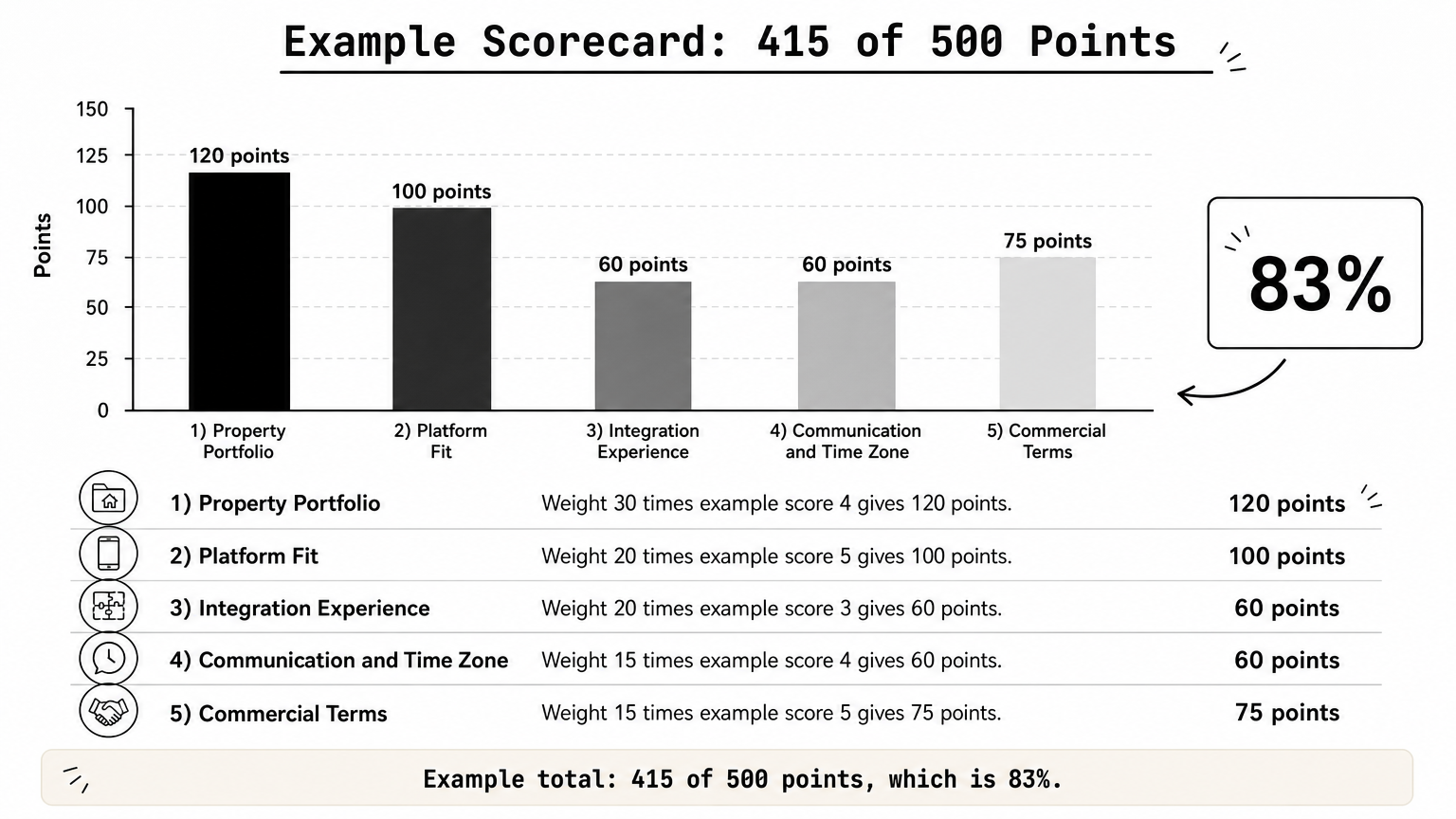
Weight the criteria by what matters most to your product, score each company from 1 to 5, and multiply. In the example below, a company scoring 4, 5, 3, 4 and 5 earns 415 of a possible 500, which is 83%.
| Criterion | Weight | Example score | Points |
|---|---|---|---|
| Property app portfolio | 30 | 4 | 120 |
| Platform fit (iOS, Android, Flutter) | 20 | 5 | 100 |
| Integration experience (CRM, listing feeds) | 20 | 3 | 60 |
| Communication and time zone | 15 | 4 | 60 |
| Commercial terms | 15 | 5 | 75 |
| Total | 100 | 415 of 500 |
Weighted scores turn a gut feeling about a vendor into a number you can defend.
Questions to ask every shortlisted company
Put the same questions to all of them, and write down the answers.
- Which property apps have you shipped, and can I speak to one client?
- How do you handle map search, saved searches and push alerts?
- Which listing sources or CRMs have you integrated with?
- Who owns the code and design files when the project ends?
- What does the quote include, and what costs extra after launch?
- Can I stop after a pilot or sprint without a penalty?
Picking your partner
A good property app partner is one that has built similar products, fits your platform and is open about scope and ownership. Use the scorecard to rank your shortlist, and let the answers to the six questions break any tie.
If you want to test Eagle Technologies against the others, start with a free strategy session and compare its scoped proposal on your own scorecard. You can talk to Eagle Technologies about your property app and see how its approach fits your scope before you commit.